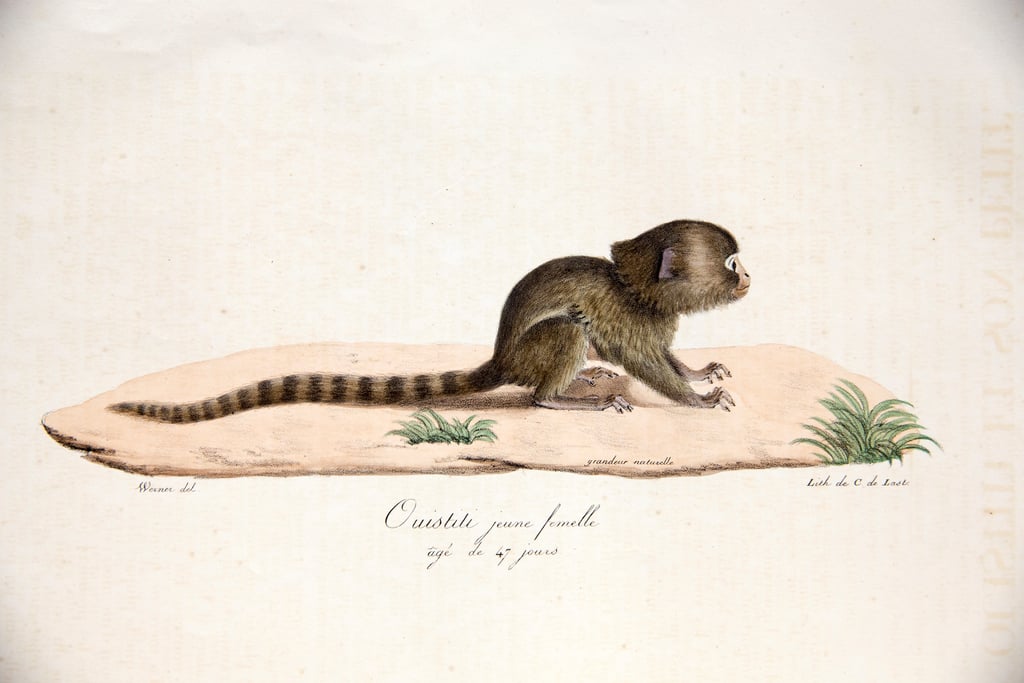
Mini monkeys are about the size of a Barbie doll, though they look more like a collectable figurine from The Planet of the Apes. One time, for their enrichment, the zookeepers gave the mini monkeys a Barbie doll smeared in peanut butter. The things they did to their long-limbed captive would make Ron Jeremy blush, Ted Bundy blanch. It was savage, if small.
The mini monkeys hate the zookeepers. As indiscriminate creatures, they hate all people--human beings. They loathe anything larger than themselves, it seems, anything bigger than a G.I. Joe, unless it’s food, in which case, the larger the better. Regarding both fear and appetite, the mini monkey doctrine applies: size matters.
Was it the zookeepers as individuals? Their lack of refined character? Or was the skittish behavior the result of evolutionary distrust, an inbuilt wariness in the pygmy marmoset for creatures of substantial physical form? Was it natural? Personal? Whatever the case, the zookeepers’ arrival would prompt the tiny primates to scurry away, retreating to the musty corners of their walk-in closet. Sadly, this is no exaggeration --their allocated “environment” is the size of an actual walk-in closet. Filled with plants, it is impossible for the zookeepers to walk. Instead, they do the limbo.
In the wild, pygmy marmosets roam 100-acre territories of Amazonian jungle. Because they are small, they are vulnerable. Because they are small, they often go unseen, avoiding a rich diversity of predation. Because they are small, so too is the target on their backs, an asset to aid the circumvention of talons, claws, and gaping maws, the inherent tools of harpy eagles, ocelots, and emerald boas. Because they are small, concealment comes easy, comes natural, assisted by the copious flora that pervades their domain.
At the zoo, pygmy marmosets hide from hairless faces that press against the glass. Square objects with screens attempt to follow them as they all but vanish among the sprawling vegetation. The curatorial director, if nothing else, got the plants thing right, yet it would seem they have missed the memo on that other 99.99 acres. Cutting corners? Clever budgeting? Who’s to say? One thing is for sure: the glass partition overlooking the cafe doesn't scream out Amazon rainforest. It cries out Overpriced cabinet food, mediocre coffee. Jittery as they are, the mini monkeys’ hyperactive antics would have you believe they’ve had too much espresso. Tweaked out and fearful, they flinch each time the coffee machine shrieks to life. For pygmy marmosets, the baristas are each a behemoth.
A typical day: A child taps the glass while he drinks hot chocolate with pink marshmallows. His fingerprints leave a resinous smear that embodies the overhead lights. He taps harder, writing his name and age in oils and milk froth, scrawling a happy face or a star --call it enrichment. From outside, a locust or cicada penetrates the enclosure. Pygmy demons emerge from chloroplast curtains, follow its frantic movements with spastic head jerks. The insect clicks. Like a radioactive motor, it buzzes, hums, drones. It hardly lasts a minute. A pygmy psychopath vaults across a swathe of broad, waxy leaves and scrambles up a network of branches to silence the arthropod’s music. Deft hands tear at fragile wings. A row of tiny, white razors flash in a gleaming, maniacal smile. A human child stops drawing doodles, recoils and spills his hot chocolate. Through the glass, he can hear the crunch of the exoskeleton, see the saffron guts oozing from a cracked carapace. Canned fruit is ignored for fresh meat.
There is rhythm to the week. Zookeepers sidestep monkey shit on the odd days, remove and clean it out on the even days. Mini monkeys are small; it stands to reason the mess they make will also be small. As it turns out, that is not remotely the truth of it. As it turns out, the zoo is understaffed. As it turns out, no one wants to spend an extra hour cleaning out the latrine that is the tiny terrarium of faux jungle. In the meantime, the mini monkeys paint a Jackson Pollock with their tiny, overactive anuses. Across the walls, over the glass, in and around their food and water bowls to mix with the cubes of pineapple and mango; a slurry of fecal stink; a warm welcome to flies and their deposited eggs. Arboreal mounds dot the nooks of branches, spread in thick application across the broad, waxy leaves of the minuscule slice of Cafe Amazon. On even days, newborn maggots are whisked away, vacated with cloths and cleaner fluid.
The mini monkeys hate the zookeeper, but the zookeeper does not hate them. She limbos three strides of Amazon rainforest, one end to the other. Her movements are awkward, graceless, and notably human. She is tracked by hidden observers, pygmy voyeurs that glare through a collage of emerald and jade. By chance, a zookeeper locks in on a frightened eye, an amber halo radiating lust that burns eternal. In that limited ember, there is 100 acres of forest, a fire that will never be doused. There is a flicker of understanding, a primal disclosure as clear as spoken words: the animal lives, but it does not survive. No wingspan from above to silhouette its oncoming doom. No feline jaws to dismember its tiny limbs. No pink vortex to herald the sarcophagus of a long, wet gullet. There is only time to wear it down. Time, and the countless observant faces.
A child taps on the glass and a tribe of forest dwellers disperse. Mini monkeys blend into a nanoscopic viridian terrain. A zookeeper stoops low, resting her hand on soft, fruit-speckled feces. Her blonde curls are like baby boas tangled in the branches. Doing the limbo, she locates the exit, leaves, closes the door.
A human sighs, a deep exhale that carries two sentiments: relief, to be free from the claustrophobic wedge of simulated rainforest, and pity, for the souls that are trapped within.
-- James Callan is the author of the novel A Transcendental Habit (Queer Space, 2023). His fiction has appeared in Carte Blanche, Bridge Eight, The Gateway Review, Mystery Tribune, and elsewhere. He lives on the Kāpiti Coast, Aotearoa New Zealand. Find him at jamescallanauthor.com