My wife and I owned a little plant shop. It was located in one of those cute pedestrian districts where locals, tourists and expats sip ten dollar coffee from knitted cozy-wrapped biodegradable cups on antique-inspired wrought-iron benches and film themselves reviewing and rating their meals and days and life experiences on their very smart phones.
The shop did well. We were happy, Marryum and I. We ate well enough and on occasion shared a decent bottle of wine. We discussed applying for a baby license and loan. Our studio apartment had ceilings just high enough to install a bunk-bed-crib above our double mattress. Yes, our place was small, but we filled it with plants and love and optimism about the future.
Not that we were one hundred percent sure. Our pillow talk was full of ‘maybe’ and ‘we’ll see’ and ‘are we sure this is right for us.’ But at the time, maybe was good enough. Maybe was great, actually, lovely and fantastic and open to a world of delightful uncertainty.
Then, overnight, Plantea opened on the same cobble-stoned street as our shop. Plantea opened on similar streets in similar neighborhoods in every city. Plantea opened shops in every suburban stripmall and outlets in every shopping center and Plantea opened booths and stands in major supermarkets and hardware stores and bargain-bin warehouse supercenters across the nation.
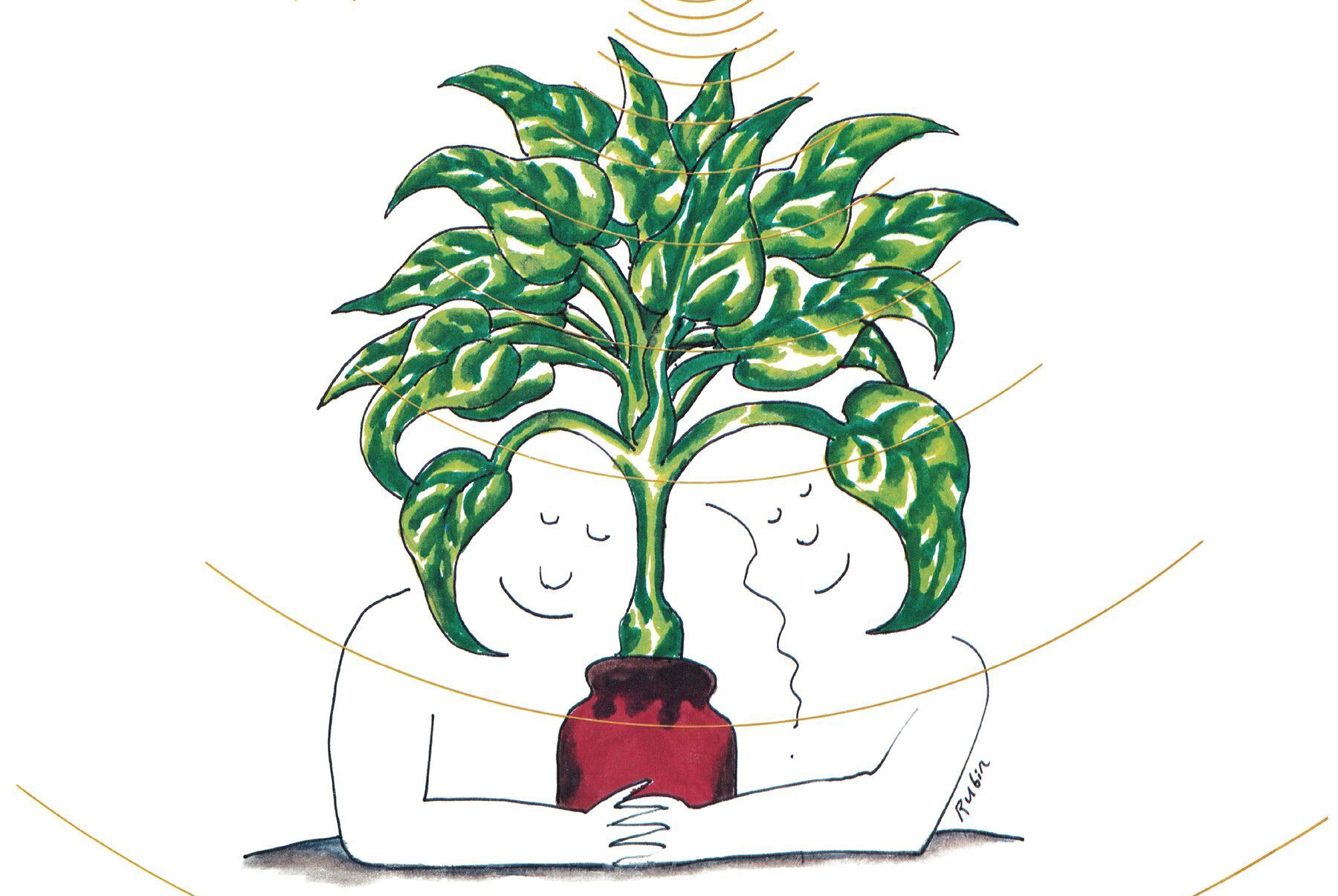
Our little shop suffered a drop in sales within days. At first, Marryum and I believed it would be their cutthroat prices that would do us in. Or their insanely fast turnover of new and exotic plants. Or their aggressive marketing and loss-leading promotions. Sure, all of these factors would have done us in eventually. But what sealed the deal was their signature item: Planteaus Accordiaus, or as it came to be called, the ‘Yes No Plant.’
***
While Plantea pushed their Yes No Plant quite hard at first through ads and deals, the company was, you might say, coy about its special properties. It was left to the first round of buyers to discover what made the plant so unique; these early buyers then started posting social media video reviews of the plant “in action.” These videos spread like wildfire. As it turned out, Plantea was owned by Bright Ash, a private equity firm that also owned one of the hottest viral marketing agencies, among other brands in its Byzantine portfolio.
One day, about a week after our local Planeta opened, and Marryum and I were trying to figure out how to remain competitive against the PE-owned national chain, we came across one of these viral videos.
An elderly lady was giving her amateur review of Planteaus Accordiaus. Her demeanor was nervous, ecstatic, as if she’d just gotten a message from a future civilization or God or some superior alien intelligent life form.
“Watch this,” she said to her camera phone, wide-eyed and giddy-mouthed. She flipped the camera to show the plant, then spoke very deliberately:
“Is it warm enough outside to go for a walk?”
At first, anyone could be forgiven for assuming that what they saw was just a breeze rustling through the plant’s leaves. After which the old lady turned the camera back on herself and beamed a look of amazement mixed with narcissistic pride, like she’d just won the lottery or successfully rigged a presidential election in her favor.
Marryum and I watched it again. And again. And read the comments. It became increasingly clear what it was we were seeing: The plant’s leaves shook ever so slightly up and down.
Yes. The plant was nodding. The plant told the old lady: Yes, it is warm enough outside. Go for a walk. Enjoy life’s little pleasures.
Yes No Plant videos trended hard: People filming themselves asking the plant all manner of yes or no questions; and the plant’s leaves rustling up and down, or side to side — that is, nodding or shaking, agreeing or disagreeing, giving its blessing or forbiddance.
We closed up shop not long after. As for our previous talk about having a baby, our Yes No Plant said it was a bad idea. In this economy… We had to suppose it was right.
***
Bright Ash, the PE firm that owned the chain of Plantea stores, as well as the viral marketing agency Face Scrape, was also heavily invested in the bioengineering industry. Whether through in-house invention or predatory acquisition of market share, Bright Ash controlled a Babylonian library of biological patents.
The firm had controlling interest in an experimental biolab company called Shwarz-Mutanda Inc. which was also heavily subsidized by the Planning Committee of Agriculture (PCoA)and the Planning Committee of Defense (PCoD), particularly the latter’s ever-growing Space Force division. It was in the Antarctic campus of Shwarz-Mutanda’s many labs where the DNA for the Planteaus Accordiaus was first synthesized.
The initial online hype about the Yes No Plant produced a fair mix of enthusiasm and skepticism. This lasted about two or three months, during which time Marryum and I both went to work in customer service farms. We were fortunate enough to find employment, although we had to share one position on different shifts: her daytime, me nighttime. Would this affect our marriage? Our plant said no.
***
Once the reality of the Yes No Plant was fully established and all mistrust subdued — thanks to a widespread Face Scrape campaign in collaboration with the Planning Committee of Information & Discernment (PCoID)— it was announced that the plant would undergo a robust period of ‘decommodification.’ What this meant was that every household in the nation would be supplied with a Yes No Plant as a public utility, with new upgraded versions being automatically delivered on a regular basis. The state would fund the program as an incentive to Bright Ash, who were free to execute it according to their proprietary market-optimized algorithms, allowing for the PE firm to avoid any financial risk.
At first, the Universal Accordiaus System, as the program was called, was a mild success with little to no controversy or material affect on people’s lives or society as a whole. People made good use of their Yes No Plant for basic inquiries:
Is eating too much butter bad for me? Is May a good time to visit southern Europe? Is this movie too scary to show my child? Do I look good in stripes? Should I sit out the next election?
So long as it was a closed, yes or no question, nobody knew, or cared, if the plant’s answer was truly correct. Things worked out fine, people adjusted their diets and booked their plane tickets and exposed or shielded their kids from a variety of entertainment or educational content.
Soon enough, people also began asking their plant more and more non-personal questions. They wanted yes or no answers to statements of fact, history, politics, science, economics, the arts, and even religion and spirituality.
Does the free market always produce the optimal price? Was Columbus the first person to discover the Americas? Is da Vinci better than Michelangelo? Is skin color related to intelligence? Was Jesus really Jewish? Were the Soviets really the enemies of the Nazis? Will I get into heaven?
It was, admittedly, faster and more efficient than looking stuff up on the internet, let alone opening a book. And the answer generally felt true enough.
***
But of course, we weren’t content to keep things at such a simple level. I remember when Marryum and I were first considering quitting our customer service jobs. It wasn’t that it was affecting our marriage, just as our plant had promised us it wouldn’t. But the work was unfulfilling, and we wanted more out of life.
Should we ask the plant if it was a good idea to quit our jobs to pursue something more creative? Maybe, Marryum suggested, we should first ask the plant if it was a good idea to ask the plant such important life questions. Only then, if it agreed, would we ask it the important life question.
Yes. And yes.
It turned out we weren’t alone. People all over the nation turned to their plants for deeper life-changing advice, often in the form of quitting their jobs in factories and schools and warehouses and supermarkets and hospitals. Nobody wanted to drive or serve or feed or clean or build or help one another in arduous and unappreciated low-paying jobs.
And yes and yes and yes. Our plants agreed it was time to quit the drudgery and toil. Go out and do something incredible with your life. Be an individual. Make your mark.
***
Marryum decided to become a sculptor. Not that she’d ever shown much interest in sculpting before, but now it seemed like it was exactly what she was fated to do with her life. She’d start small, with bookshelf figurines and paperweights, assuming one day soon enough the commission for large-scale works would follow that would allow her to edify the public’s hearts and minds.
I was going to discover a non-medical, non-chemical and non-invasive cure for depression, anxiety, paranoia and maniacal selfishness. I quickly sketched out some experimental ideas: spending more time outdoors, listening to classical music, getting really into upcycling trash, championing the cause of a less fortunate demographic, extended periods of staring into the camera phone and repeating ‘I love you,’ and ‘it’s not your fault,’ and ‘still you could do better.’
Meanwhile, the value of every company in the essential industries plummeted. Bright Ash went on a buying spree and gobbled up control over trucking and transportation companies, agricultural and food processing firms, supermarket and pharmacy chains, construction conglomerates, plastics and chemical companies, fast food franchises, and customer service farms.
Due to a massive drop in income tax revenue, Bright Ash was able to forge new partnerships with the government to kickstart a massive privatization program. They took contractual ownership of hospitals, school systems, public transportation, communication infrastructure, and the energy sector.
Eval Kass Tech Ltd., a Bright Ash-owned robotics firm, would handle the manning of those industries, partly with the aid of a massive subsidiary from the Planning Committee of Corrections, Order and Presentability (PCoCOP).
Most people, Marryum and I included, hardly noticed the transformation. We were too wrapped up in discovering ourselves, fueled by the steady flow of encouragement coming from our plants. Others were merely distracted by the instant ease of information and belief-confirmation that a simple primitive yes-no organic machine made possible.
***
It’s been several years now since the Yes No Plant was introduced.
Our cities have never been more beautiful. Every part of every metropolitan area is now exactly like our cute little district with cobble-stone streets and colorful awnings and wrought-iron benches. There is, obviously, a lot more plant life: lush and verdant and swaying in the wind. Conversely, there are much fewer of us to enjoy these things. But life, and its pleasures, are scarce, so we’re told. And plants require a lot less fulfillment than we do.
Marryum and I are still here. She too has never seemed to me so beautiful as now, weighing less than half of what she weighed in the past when we owned our little shop. I can see the gorgeous branch-like vein system glowing through her fine skin. She also loves to tickle my bones, literally, as they increasingly protrude from my delicate flesh.
We don’t work anymore, which is great. Who wants to edify the people or save the world anyway? Egoism is very unattractive. Most of the time we languor about, waiting for our feed deliveries. It’s plenty for the two of us, but it would be impossible to sustain a baby, which is also fine. Saves us from having to make that tough decision once and for all.
***
This way of life was far from guaranteed, however. There was a time when a radical group of activists were aiming to discredit the Universal Accordiaus System and take down Shwarz-Mutanda and Bright Ash. At the same time, another radical group emerged demanding equal rights and citizen status for every member of the Planteaus Accordiaus species. What began as a small-scale debate soon escalated to the brink of civil war.
Thank God, or aliens, it never came to this. What halted this historical trajectory was the revelation that Face Scrape was behind one, or both, of the radical groups. The entire thing was supposedly a publicity stunt. Nobody’s sure if this is actually true, but nevertheless, peace was restored by the revelatory headline drop.
When questioned on live television about the Face Scrape-Bright Ash-Civil War scandal, the Coalition of Rivalrous Presidents (CoRPs) insisted the question be put to the plant. But not the Yes No Plant. Plantea would soon be rolling out an evolution of the Accordiaus: Planteaus Fragentus Udicatus.
***
We have one of those now, Marryum and I. When you put a question to it, sometimes the leaves rustle up and down, other times side to side. But mainly, it appears as if a gentle breeze passes through the leaves causing them to roll up and around just once.
In other words, it shrugs. We call it the Maybe Plant. Some questions it’s been consistent in shrugging off includes:
Does showing scary movies to my kids make them more obedient? Are there any parts of the world worth visiting that are cuter than here? Are spores really that unhealthy to breathe? Is this the best of all possible economies? Is vertigo and nausea really a product of too much uncertainty? Does my wife truly love me? Is there more to life than this?
Sometimes, ‘maybe’ is the only salvation left. As long as it comes from a trustworthy authority.
-- Michael Zunenshine is an assemblage of mismatched parts of a writing machine. The output can be consumed at several fine locations, such as: APOCALYPSE CONFIDENTIAL, Expat Press, Close to the Bone, Terror House Magazine, Soyos Books, D.F.L. Lit, Pere Ube, and Otherwise Engaged; or you can access a catalog directly from the manufacturer here: linktr.ee/realitytvdinner.