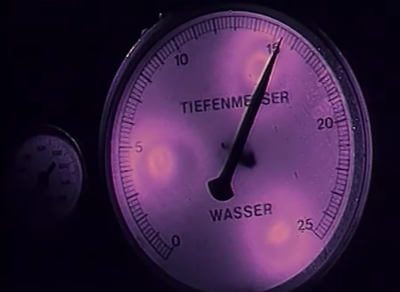
". . . always more, and not just more, and not just always, always more than more in thinner and thinner slices of time, cross-section of the MRI . . . the spike in the blood and the intravenous metallurgy surging . . ." -- Michael S. Judge, POST-SOLAR HISTORIES
Plethora Dietz was an electrician. You’re invited to disregard his birth, naming, rearing, education, recruitment, and training which will all have exited his memory once we happen across him. In the service tunnels beneath the compound, his place of employment and solitary residence, he shuffles like an autonomous vacuum cleaner. You could have asked him how he wound up in these tight cement hallways without a spotter, one out of hundreds of highly specialized technicians keeping the place running, the sole electrician. He would only go glassy-eyed and chew on his bottom lip a moment before struggling to describe to you, who do not live in the compound, the persistent and localized electrical storm which aboveground ruptured the reflective roof Dietz and his co-technicians called home, grounded itself in the walls’ wiring, frying it, driving him underground to haggle with his grid for more current.
Division of labor was strictly enforced on the compound. Engineers of the same specializations shared homes and labs, but never even spoke to those of others. This was understood by all to be for the good of the compound which, for reasons unknown — really known, but not to anybody Plethora could speak to — would totally collapse without its culture of obtuse, redundant secrecy. He regularly daydreamed about an unimaginable night succeeding the even less imaginable morning shift change when too many engineers on too various teams got to be willing to work with and live with and sleep near each other and caught hares asswise to pack it up and quit, strike out to put together a compound all their own, no more teams.
Plethora was less an engineer and more a custodian, so not even part of a team, confined to regular, pedestrian listchecking and the odd troubleshoot. This shot of trouble was the oddest in working memory, no previous storm or checklist severe enough to funnel him into the dim channels down the hatch. Channels which, the longer he walked, it dawned on poor Dietz, seemed to extend further and further beyond the bounds of the compound above.
Dietz had nothing to do with the construction of these eldritch tunnels or the buildings they served. He had a smaller-scale competence. Framing a building, wedging into its negative space, and actually laying the wires is not only strenuous, but impossible to accomplish without a crew or at least a partner. Dietz had it easy: no squeezing, contorting, climbing, crouching, cohabitating, not even conversating. His duties amounted to walking around and dusting. Once it’s installed, electricity might as well take care of itself.
But the electrical storm up there ignoring meteorology, sustaining itself without any flux of wind or moisture which you can tell by the absence of clouds for miles around the compound, having so sustained itself for what must be months now, the whole time Plethora remembered working here, you could hear it from everywhere inside the place, the sound of a heavy membrane inverting in perpetuity, would pass underneath its eye during rounds at any hour the management team had scheduled rounds, see the heat creep through the alloyed ceiling day by day, orange reptile pupil brighter and brighter until with an onomatopoeia the ceiling fissed open and through the hole in the ellipse dripped sky. Around then the lights went off.
As unfamiliar lights flickered on, every piece of emergency training flashed back in kind behind his forehead. Emergency fluorescence falling on his shoulders, intrepid Plethora exited through an emergency window and found the outdoor emergency hatch through which we bear down on him retracing orange wall lamp breadcrumbs to that Hexenhaus, the breaker panel. For Dietz the hall might as well never end, countless tubes glowing overhead, immeasurable intervals from one to the next, all duration between them dilated beyond recollection, time pinched at either end and bowed inward from a flat line to a pocket fatly opened by the succeeding moment. As soon as he got to the breakers he grounded himself with his keys, all 2 of them, his key to the panel and the key to his room, and he briefly understood how it felt to be a radio antenna or a groundwater well.
More understanding after that. Ribbons of it. Rolling pleats. Curtains. Quilt swaddled. Patch worked. Clock stopped. More than only current. The medium flowed along sides. Mercurial. Could see it from no knowing where. Notlooking closeyes. Couldn't see his bloodstream if he tried. But saw the liquid metal. Saw his heart start, galvanized, pumping quicksilver blood, veins mirrored. Dietz’ own grid killed him but the storm, the compound pulled him through.
More pulling. Dietz stretched solid like a lead balloon, a novelty penny pressed taut into one surface from the next. Felt his freshly minted edges melt. Blinked or opened his eyes for the last time. He was a pair of walls now. Floor and ceiling. Topheavy. Horizon and the humidity weighing on it. Every inch of him became distributary from the inner surface of the compound. Closed circuits trickling off the rapids of a distant enormous transformer. The hole the bolt left in his domed top popped shut. Good as new — all the reflectivities started focusing light amongst themselves, funneling it up toward the storm, then grounding it again to nourish their particular nibbles of grid. It was a wasteless little system other than the periodic need to waste an employee. He hadn’t been the first electrician digested, or engineer, mechanic, manager, custodian — Plethora came to know every last one.
-- Lucas Mancini is neither an electrical nor chemical engineer. He is not a sanitation engineer either. See more at Bridge Eight Press, BRUISER Mag, APOCALYPSE CONFIDENTIAL, and @mangiafakir.