Emily awakens to three text messages, all from the trail camera synced to her phone. The solar powered trail cam is mounted to a tree about a half mile deep into the woods that border her family’s house along the south. The house has been in her family for generations, as have the woods, about ten acres of it.
The camera is pointed at a small clearing in the forest that has been known to attract wildlife, and it’s motion activated, automatically springing to life and recording when even the slightest movement is detected. Emily opens her app to see what popped up while she was sleeping.
There are three videos, each under 45 seconds long. The first is a porcupine gnawing on the bark of a young tree at the outer edge of the clearing. It’s tagged 6:37 p.m. so just before sundown, meaning the video is in full color. It ends when the round little porcupine tires of the tree, and saunters off.
The second video is a moose, full-grown, meandering in lazy, lackadaisical strides across the clearing, periodically lowering its majestic antler-crowned head to graze on the tall grass along the way. 11:02 p.m. so the camera has now switched to night vision, casting the moose in an eerie, gentle glow, its eyes bright hot white in the darkness.
When Emily opens the third video she immediately sits all the way up in her bed, and for 32 seconds there is nothing else in the world except this: On the screen now is a manmade structure covering the entire clearing, the trail cam capturing the long white wall of it, and leaving the rest to the imagination, and Emily’s imagination is running wild right now. 3:44 a.m. This structure was not here four hours ago. Hasn’t, in fact, been here in close to 70 years. Emily nearly drops her phone when a lanky man in a suit suddenly walks into frame, looking right at the camera with white glowing eyes, his old suit cast in the same otherworldly night-vision sheen as the structure, and the man slowly lifts his arm to actually wave at Emily. Without thinking, Emily kind of waves back, as if he could see her, as if the scene she’s watching on her phone hadn’t already finished playing out hours ago.
Emily has her share of personal flaws, as everyone does, along with two ex-husbands, former friends, enemies, and estranged family members who wouldn’t hesitate to read her a comprehensive list of them at any given time. But one thing nobody has ever accused her of is being delusional, and so Emily doesn’t bother pretending that what she’s watching on her phone is something other than it is. She doesn’t pretend that the structure she’s looking at right now -- the very reason that there’s a clearing in the woods in the first place -- isn’t a church house that was built in 1949 and torn down just a few short years later, stripped for reusable parts and shipped back to Albany or Boston. She doesn’t pretend that the man isn’t her great uncle, who died a full decade before she was born, leaving behind only the kind of strange and unwieldy legacy that often attaches itself to eccentric men, especially eccentric men who build church houses in the middle of the woods and declare themselves founders of some odd and incoherent new religion that only they truly understand.
Emily notices that the great uncle waving at her through the trail cam is smiling at her, all big glowing teeth, and even through the general spookiness of night vision, what Emily feels most strongly is that the smile isn’t sinister or conniving in any way. Her great uncle is actually just truly smiling at his grandniece, is so happy to see her, is so happy to be back after so long away, so that he can finally finish what he began.
And Emily knows that the reason she’s seeing all of this right now on her small phone, tucked away in this quiet and overgrown corner of Berkshire County, Massachusetts, is because of her. Because of what she found in those old boxes forgotten for decades in the basement crawlspace of her family’s house, and the journals and the odd story hidden in the journals.
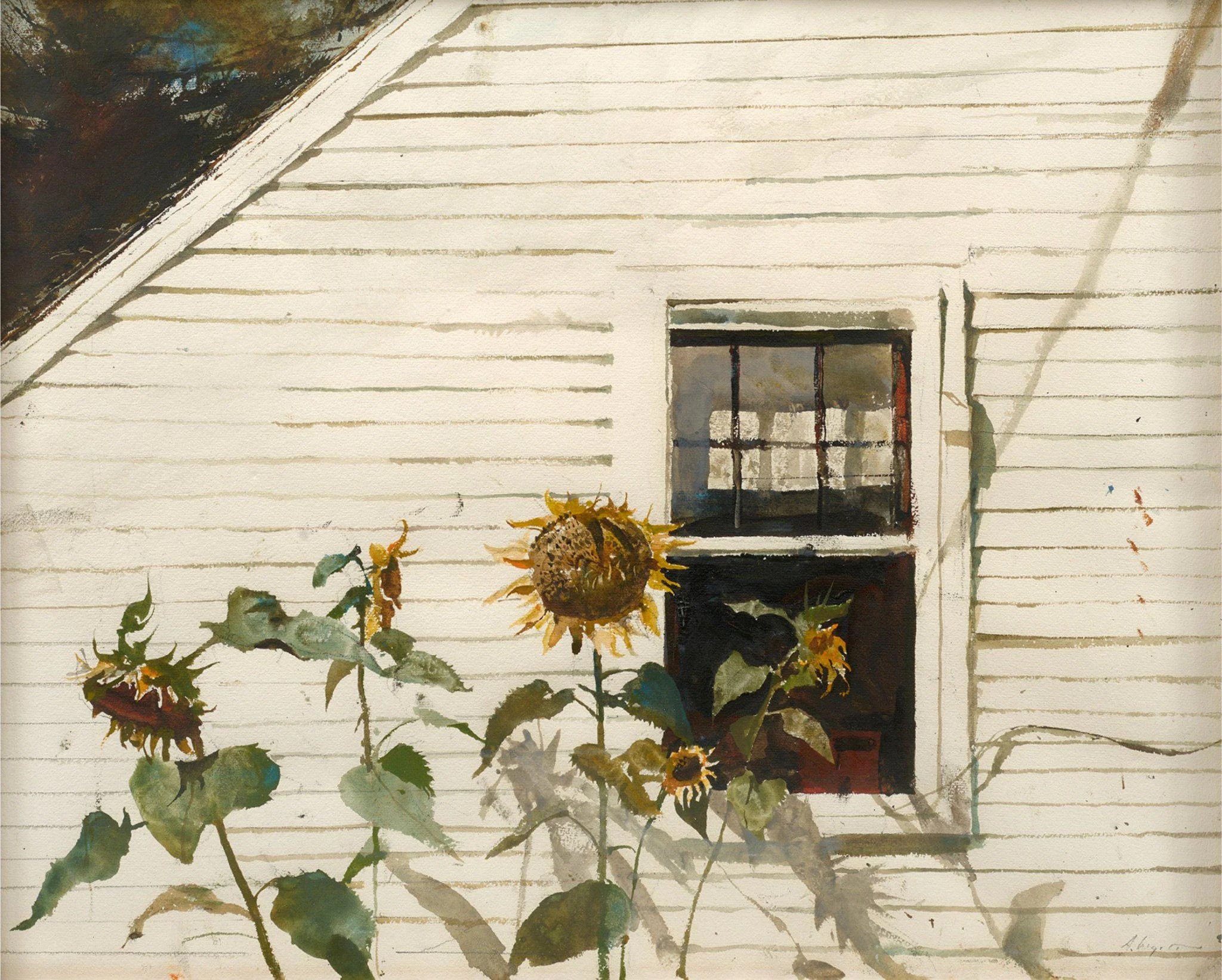
Just before the video ends, Emily sees at the corner of the church house a lone sunflower, taller than her uncle by several feet at least, glowing brighter than anything else on the screen. In half an hour Emily will walk out to that clearing in the woods, but her great uncle and his church house will be gone once more, will have vanished into the sky just as suddenly as they appeared. The only thing she’ll find there is this sunflower. Before she powers her phone off, she checks the date. Her flight leaves in one week. In one week this country will be unrecognizable.
***
Two nights ago Samantha sent a text to everybody in book club and said sorry for the last-minute change of plans, but would anyone mind if instead of discussing the novel we’d planned for book club this week, the New York Times bestseller that everybody had to steal time between taking the kids to soccer and feeding babies and working long hours and barre class and everything else, could we instead discuss this weird short story that Samantha came across kind of randomly but hasn’t been able to stop thinking about. And don’t worry, it’s super short.
Samantha’s hosting this month, and the host picks the book anyway, so everyone begrudgingly says sure, send it to us, which Samantha does, and that’s when everyone in book club discovers that this is an unpublished story that can’t be found anywhere online, so Samantha has to actually send four photographs to the group text, a picture of each page with the story scribbled on it by hand, so everybody has to read it on their phone or laptop like this, which everybody does that very night, because like Samantha said, it’s short.
Samantha says that her friend who’s staying in this old house out in the Berkshires sent the story to her just like this, that she’d found it with a bunch of stuff that belonged to, like, her great uncle or something who was apparently this pretty weird guy who’d amassed a small following out in the country in western Massachusetts after World War II, he was basically a cult leader, and he wrote this. Samantha says her friend just sent it to her, asking “Can you figure this out?”
But here’s the weird thing everybody realizes as they’re reading the story: There’s nothing to figure out. The story is four pages long, maybe a thousand or two words at most, and it’s really pretty straightforward. It’s called “The Sunflower Farmer '' and it follows the titular farmer over the course of a single day, from sunup to sundown, tending to his vast and lush field of sunflowers, presumably the only crop he grows. There’s no real plot or movement, no mystery or metaphor, and if the sunflower farmer has any interior life at all, it’s never mentioned in any of the story’s four pages.
And yet, in the approximately 48 hours from everyone reading “The Sunflower Farmer” until they’re all crowded together in Samantha’s studio apartment, nobody can stop thinking about this story. There is not a full minute in any of the book club members’ days that isn’t devoted to trying to sort out the puzzle that is “The Sunflower Farmer.” Because for all of the story’s plainness, for all of its competent if unimpressive prose, and completely average existence as a piece of unexceptional barely-fiction, one thing is abundantly clear above all else to everyone who reads it: There is something wrong with this story.
For five hours -- more than double the length of the book club’s longest meeting -- they try to figure out what it is about “The Sunflower Farmer” that is having this effect on them.
Samantha: So now you guys understand why I needed you to read this, right?
Ana: I just don’t get this at all. I’ve read it five times now, and I can’t put my finger on why it’s bothering me so much.
Nik: Right? I keep feeling like there’s something I’m just missing, and if I read it again I’ll finally catch it.
Erin: Like it’s a jigsaw puzzle missing a single piece somewhere, but I don’t know what the piece looks like or where it even belongs.
They go around and around like this, dissecting every sentence of the story for clues, googling images of different varieties of sunflowers to see if that might jog something loose, literally acting out all of the sunflower farmer’s steps in the story to see if something doesn’t add up.
In fact, it’s during this roleplay when Natasha finally catches something significant. At the beginning of the story, the sunflower farmer approaches the field from the east, and all of the sunflowers are facing him. But at the end of the day, the farmer exits the field from the west -- basically following the trajectory of the sun -- and yet the sunflowers are all still facing him when he leaves. Meaning every sunflower somehow reversed position by 180 degrees over the course of a single day. A wave of excitement rolls across the group for having finally solved the riddle of “The Sunflower Farmer” until Ana ruins everything by googling this and discovering that, no, unfortunately, this is something sunflowers actually do, through a phenomenon called heliotropism, in which sunflowers can turn their bright yellow faces to track the sun throughout the day. The book club is crestfallen. They were sure they had it.
Twenty minutes before the book club decides to adjourn for the evening, no closer to solving the mystery than when they started, Natasha’s fiancé Oren is at home uploading “The Sunflower Farmer” to his computer, via an app that scans and transcribes the words from the pictures Natasha shared with him, into text that he can copy and paste, which he does onto Reddit, credited to “Author Unknown” and with the tantalizing prompt: Help, I can’t stop thinking about this weird story. If anyone can figure out what’s wrong with it, I’ll venmo you fifty bucks no questions asked.
Which is all it takes. Within hours “The Sunflower Farmer” is the top post on Reddit and two days later it is viral absolutely everywhere: Twitter, YouTube, TikTok, Facebook, and a hundred million other small corners of the internet, where people compete with one another to be the first person on Earth to definitively solve “The Sunflower Farmer” once and for all, oblivious to the changes occurring in their neighborhoods, on their blocks, in their yards, unaware of the total monoculture devouring everything in its path.
***
Dad and I board a train at Penn Station, destination Albany, and I spend the whole ride just looking out the window at all the beautiful trees and rivers and lakes and hills that keep getting bigger as we get closer to Albany, and then we get off in Albany and Aunt Eunice is waiting there to pick us up and drive us to Pittsfield which is where we stop for lunch at this diner, and I swear Dad and Aunt Eunice don’t say more than three words to each other the entire time, which makes sense, because we’re really here to see Uncle David and Dad has never liked his brother’s wife, it’s pretty obvious to me.
We drive half an hour from Pittsfield to this big house out in the middle of nowhere and as soon as we pull up Uncle David walks out of the house, and he’s so tall and scrawny, looks kind of like a scarecrow, and he’s got this big smile on his face, and even though it’s a decent walk from our car to the front door, Uncle David crosses it in just two steps it seems like, and he gives Dad a great big hug which I can tell embarrasses Dad, who never hugs anybody if he doesn’t have to, and then he lets Dad go and turns to me and picks me up in his arms and spins me around and sets me back down and pokes my nose with his long finger and tells me he missed me and he likes my blue dress. Dad says I’ve met Uncle David once before but I was so little I don’t remember. I play in the yard for a long time and chase wild turkeys and squirrels and chipmunks while Dad and Uncle David talk on the porch, and then after dinner Uncle David tells us to get a good night’s sleep because in the morning he’s going to show us something amazing.
Dad wakes me up at the crack of dawn and tells me we’re going to church, which is news to me because we hardly ever go to church in New York, and he says this is actually a church Uncle David started, and he kind of gets a funny look on his face and says it might be a little unusual, but it won’t last long, and to be a good sport, which I am, so I put on a yellow dress this time and when Uncle David sees me, he tells me this is the perfect color for today. Uncle David is wearing a nice suit.
Instead of all getting in the car like I thought we would, me and Dad and Uncle David and Aunt Eunice instead walk on this narrow path behind their house that leads into the woods, and I ask Uncle David where we’re going and Uncle David says we’re going to his church and I ask him why he built a church in the middle of the woods, and he turns and kneels down so he can look me in the eyes and he says “Because that’s the point of it all.”
When we finally get to the end of the path, there’s a small white church house that’s basically one big room and looks like it was just recently built, and I can’t tell you how odd it is to see this thing just sitting here surrounded by trees and brush when the nearest road is miles away. When we walk inside there are just seven other people waiting, who I guess all walked here too, and they’re all huge smiles when they see Uncle David, because it’s clear they love him and look up to him, and Uncle David goes through and hugs them one by one, while me and Dad and Aunt Eunice sit in a pew, and even though there are enough pews to seat maybe 50 people, I get the feeling this is as many as we can expect, which makes sense because I didn’t love walking through a forest and getting my nice shoes all muddy, and I imagine most other people don’t either.
Uncle David gets up to the pulpit and extends his long arms so wide they look like they could almost touch either side of the church and he announces in a deep booming voice “The Great Monoculture!” as though it’s self-evident what that’s supposed to mean, but the looks on the faces of the other congregants, fully enraptured, suggests they do know what it means and I just don’t understand it because I’m 12. Uncle David then delivers what I suppose you could call a sermon, but is really more a long list of excitations and a random assortment of things he’s enthusiastic about. He says he has met with the Shakers of Pittsfield and elsewhere, and he has received with great enthusiasm their ideas of American Utopia. He says he has seen with his own eyes what two great wars have done to our nation and the men and women who keep it running, and our nation’s soul is sick, but sometimes a soul is made sick so that it can be made healthy again, healthier than it could have been otherwise.
He says he has wept before the Tetons and scavenged for food in the Badlands and been broken and fixed once more in New Orleans. He has seen every corner of this great nation and he knows America is building toward something, speeding toward a wild and total sublimation, a euphoric conclusion that is not a conclusion at all but rather a new beginning. He says he has met with a man named Achilles Rizzoli in San Francisco, who had visions of another world filled with brilliant and impossible architecture he called the Y.T.T.E. which stands for Yield To Total Elation, and he wants to mobilize a hundred thousand men to tattoo this in big letters across the continental United States. He says he has read the diaries of John Woolman, the great Quaker mystic and abolitionist, who dreamt of a brilliant orb of light appearing in his bedroom and repeating the words “Certain evidence of divine truth.” He says divine truth is coming to our country soon.
He talks about sunflowers. He says he peered into the face of a common sunflower in Kansas and he saw only pure truth within it, and he believes that sunflowers -- which are native to our country, were first cultivated here four thousand years ago -- hold a truth for us, and that truth is an end to war, an end to death and suffering, an end to trying to hold onto that which cannot last. He picks up a bag from behind the pulpit and says in this bag are exactly eleven thousand sunflower seeds that he acquired from the beautiful nearby Shaker souls he befriended, which is one thousand sunflower seeds for every person in attendance today -- himself included -- and we are called upon to plant these seeds on the grounds around the church, and 10,999 of them are doomed to fail, will never germinate, but one of them will lie dormant for a very long time and then one day grow, and when it does, it will start something beautiful in this country, something perfect and holy that can never be undone.
So in other words, I have to plant a thousand sunflower seeds, even though in all likelihood every single one of them is a dud. We all stand up and walk outside and Uncle David gives everyone a stick and a bag of seeds and we all spread out around the church, poking our stick into the ground, planting a seed, and then doing it again, over and over. My yellow dress is filthy by this point but Uncle David, still smiling, says “Do you see now why I said your dress was perfect for today?” and I nod, and then he looks up into the sky and puts his arms out again and says “Now you see, Emily. Now you see.” Dad looks up from his planting and gives Uncle David this look that says he could just about murder him right now, with his bare hands, outside his own church, but he just quietly and angrily keeps planting his seeds, and about two hours later when we’re all done, everyone politely shakes hands and then walks in silence all the way home.
After Aunt Eunice drops me and Dad off at the train station in Albany, Dad sits me down and tells me that Uncle David isn’t well, and he’s sorry he brought me here. I tell him it’s okay, but he says no, Uncle David hasn’t been right since the war, and he’s not a priest or a preacher or a pastor or a rabbi, and certainly not a man of God, and it’s right then that I realize that God never came up once during Uncle David’s strange sermon. Or the Devil, for that matter. Dad tells me that when we get back to New York he’s going to take me and Mom out to a fancy dinner to make it up to me, and then he hugs me and holds the hug for a long time, much longer than I’m used to with him. And we ride the train in silence all the way back to the city, but the whole time all I can think about is that beautiful name, the name that sounded like a song from another land, a heavenly place of light and calm abiding. Emily.
***
--This has to be Monsanto, right? This has Monsanto’s fingerprints all over it. Or some other shady agricultural conglomerate.
--My husband is director of our town’s parks department and he says he’s never seen anything like this. They can’t even cut back the sunflowers fast enough to keep up and some of their stalks are so thick they practically need a chainsaw, and you can guess how many chainsaws we have on hand at any given time with our annual budget.
--It’s some kind of hyper-aggressive strain, or a hybrid seed or something. Whatever it is it’s not natural, for it to be spreading the way it is, all out of control. This was something cooked up in a lab, mark my words.
-- I mean there are worse plants that could go crazy like this haha. Could be poison oak or like mutant venus flytraps or something. At least sunflowers are pretty to look at.
--It doesn’t matter what plant it is, a monoculture is incredibly bad. All of our ecosystems rely on biodiversity. One species (even something as beautiful as the sunflower, granted) taking over everything has a lot of huge, negative implications. Things can go south really fast. They already are.
--I was walking Rocco this morning and some of these sunflowers are no joke ten or fifteen feet tall, and I swear they weren’t there just a few days ago.
--What I don’t get is why this is only happening here, in America. Not even crossing our borders. Like, what does Canada and Mexico know that we don’t? You can’t tell me they were able to figure out how to stop this and we couldn’t. Come on. Oh and we’re just supposed to accept as a coincidence that all this is happening right at the same time that weird sunflower story goes viral and makes everyone lose their minds? This is pretty basic psy-op stuff.
--We just got word. Everyone in the office has to work from home until further notice. Some of the roads are getting inaccessible. Any crack in the pavement or really any soil at all, sunflowers shoot right up. Have you seen some of these videos out of Chicago?
--Yeah, really scary.
--Well, I still think they’re pretty.
***
By some miracle, Emily manages to catch the last flight out of Boston before all the airports are shut down for the foreseeable future. Everything happened so fast, but through it all Emily has remained calm and focused on the task at hand. Her only luggage is her carry-on bag. Inside of it: Her great uncle’s journals, which her mother requested. Written on her palm in sharpie: Certain evidence of divine truth. She doesn’t know why she wrote these words or where they come from.
As her plane ascends, climbing up up up toward the clouds, she sees only fields of sunflowers sprawling out in every direction from her window, as far as the eye can see, reminding her of that morning in the clearing in the woods, finding the lone sunflower standing tall and stoic, taking the thick stem in her first and shaking it just a little, the seeds gently falling to the ground to be spirited far away from her by mice and chipmunks and the wind and so many birds, to every corner of this beautiful and damaged country, to create something new in her great uncle’s image. She thinks of him looking at her through the screen of her phone, smiling, knowing.
She’s lost in thought for hours before the pilot interrupts her reverie, informs the cabin that they’ve tried and tried, but they can’t find a clear runway to land on anywhere, and they’re precipitously running out of fuel. At some point they’re just going to have to go for it, try to land this plane in a sunflower field, but it won’t be easy, will be quite dangerous in fact. He thinks there’s maybe a 50% chance the plane will suck a bunch of sunflowers into its engines and blow everyone up. He knows that’s hard to hear, but he just wants to be honest about what’s happening. Like so many others, the last week has changed him. He seeks only truth. He intends only for his words and actions to be an honest expression of his true self.
Emily wonders briefly if she’ll make it home to her mother after all, her mother in Kansas, the Sunflower State. But she sees that she will. She sees it all ahead of her, the plane landing in a vast and endless expanse of gorgeous yellow and orange and red sunflowers, the passengers filing off the plane one by one, and setting foot in a new world. And their hearts are so full and glad for all of it, for the monoculture, the danger and the wonder of it all. With the wide open land of these great United States, just as he imagined it, rushing toward her she sees it all, yes she sees perfectly, and she is not afraid of anything.
-- Chris Scott's work has appeared in The New Yorker, The New York Observer, Maudlin House, Flash Fiction Magazine, Weird Lit Magazine, The Fantastic Other, Flash Frog, and elsewhere. He is a regular contributor for ClickHole, and an elementary school teacher in Washington, DC. You can read his writing at https://www.chrisscottwrites.com.