(38’ 16’’ West; 5’ 13’’ South)
Otílio measured out the distance in leagues, hours and canteens.
Alto Sertão to Mossoró, on foot through scrubland familiar in the drover trade, was, respectively, 12, 18 and two; for Otílio, a trial, for Maria, a Via Crucis. Otílio would add--to her frailty as a woman—unbearable pain, depravation and despair.
She would die in the Brazilian scrubland; she would beg to die.
The thought lent him comfort.
Otílio labored, that day, at the sweltry stables, familiar ground for drovers. He stacked hay, cleaned stalls, swept up fetid horse and bird droppings from the pale slate walkways. He betrayed thinly disguised pride at the simplicity of his plan. At noon, he downed a sugar whisky with the blacksmith, his friend--the friend who would do him a priceless favor. To collect the favor, Otílio donned goggles and a patchy leather apron, faced the smith’s blazing forge and plunged a discarded branding iron--the blacksmith’s gift--into the fierce flames.
“How long?” he asked.
“Only a minute or two, until it’s white hot…it’s a skinny little thing.”
Otílio bent over the forge like Vulcan. The heat seared his cheeks. He was fascinated by the yellow fire, how it licked the black iron then sheared off ply after ply of white foil in curls. The swirls at the tip of the branding iron turned red, then gold, then white with blistering heat. Otílio massaged it in the dancing flames. He didn’t mind the heat. He examined every bar and twist of the metal like the owner of a newly cut diamond.
“That’s enough,” said the blacksmith. “You don’t want to murder your sow, just brand her.”
Otílio nodded. He removed the goggles. He smiled in appreciation.
“Now, get on with the business,” said the blacksmith. “It will lose its sting and won’t make an impression.”
Otílio walked the beaten-earth path that skirted the river. He flourished the hot iron like a scepter. The river marked the limits of Alto Sertão; it was more a sewage canal than a stream; on hot days, its stench rose as a visible mist that swelled above the water. Otílio reached the two-room shed where he lived with Maria. She was sleeping in the afternoon heat.
He had planned this.
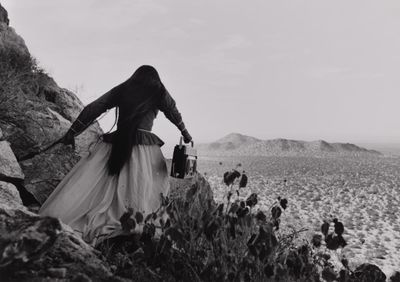
Maria lay curled on the tick mattress. She wore a white smock. She was slim, dark skinned, her features pinched in and childlike; a cousin who owned a salon in Alto Sertão cut her hair every week; it hung in strands like black spikes to the nape of her neck.
Otílio placed the iron on Maria’s bureau, the bureau her mother gave her, the sole possession which lent her pride, the bureau where she kept white and gray smocks, a hairbrush and a bed sheet. The tip of the iron was still hot but the color had changed from white to pink. It emitted a faint stench of ferrous oxide and dung.
Otílio donned his leather hat; in the march across the desert, it would block the worst of the afternoon sun. He fetched the two canteens he had prepared and slid them onto his belt. He didn’t remove the leather apron; it might prove useful in the scrubland.
He bent over the mattress. He called: “Maria.”
Maria looked up at him with wide, dark eyes. She frowned. She swung her legs across the mattress; her bare feet found the floor. One side of her face, the side that had been flush against the mattress, was sweaty.
He called again: “Maria.”
She looked at him with puzzlement and irritation.
Otílio picked up the branding iron and in a swift, almost casual motion, pressed it against her forehead and cheek—on the sweaty side so it sizzled and then stank like rotted bacon on a griddle--then he yanked it away. Maria fell sideways onto the mattress; she tried to smother the wound with both hands; the only sound was a fleshy clap as her hands hit her face. She opened her mouth in shock but could not scream. Her little chest heaved but even her breathing was silent. She looked up at her husband with unbelieving eyes.
Otílio looked back at her in casual disgust like a man watching a rat die of poison.
“Get up!” he ordered. “Get up or I’ll do it again!”
He pulled her to her feet, pushed her past the bureau, out the door of the little bedroom and into the narrow galley at the front of the shed. The galley quickly filled with a scent like burnt oranges. It left a taste in Otílio’s mouth that reminded him of dried blood. Maria began to whimper. She kept her hands pressed against her cheek. Her body shook.
Otílio pushed Maria into the searing white sunlight. She bowed her head. He poked her with the iron to keep her moving.
“Keep going,” he ordered. “Keep going or I’ll stick you with it again.” She stopped and looked at him. He brandished the iron but the tip was blunted and bent now; the color had faded to mottled yellow like dried clay.
“March!” He ordered.
He poked and cajoled her to the end of the beaten-earth path. They crossed the river on a bridge made of wooden slats. Her white smock fluttered like a shroud.
On the other side, Maria stopped again. Her hands dropped to her side. She felt no pain, only the presence of the hideous mark on her face. She searched the pockets of her smock; she found half a white guava; she resolved to keep it hidden.
Otílio tossed the branding iron into the stream. With two hands, he shoved Maria in the back.
“Move!” he said.
She lurched forward.
“Move!”
She began walking, taking proper strides like she did to the market or the shed where the seamstress worked alongside the washer women at the place where the stream widened into pools and the water lost its oily stench.
She felt no pain in her bare feet. She was tempted to touch the wound on her face again but thought better of it. Although she felt nothing, she knew the pain would follow later; she imagined it would come and go for a while then burn like candle wax.
She resolved not to turn back to Otílio. She would give him no satisfaction, no hint of pain or betrayal. She could hear him behind her. She heard his leather boots on the dry clay, the pebbles and the stubble of brush. The three little straps of his leather hat slapped against Otílio’s face like whips. He was muttering under his breath. She couldn’t make out his words; she didn’t want to.
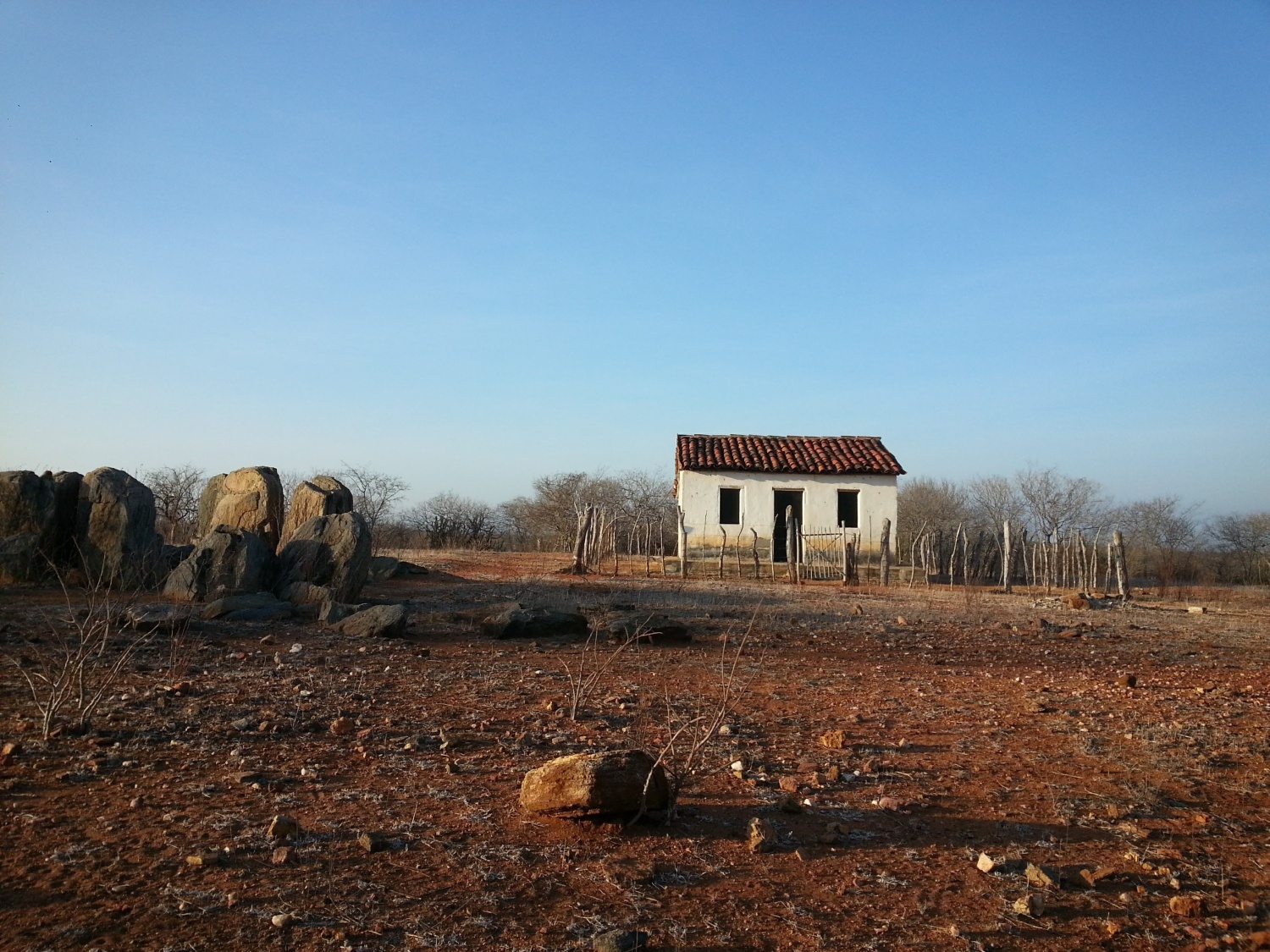
Before them, stretched the sertão. There was no path, no hint of dwellings, no electrical or telephone poles or wires, no animals browsing in the brush, barely a clump of trees, a few wiry black birds. There was a faint scent of dried fruit, little movement or sound, just searing white heat.
Otílio began to sweat. Over a distant horizon hung a few white clouds; otherwise, the sky was bare slate. The sun was behind them; it had turned the sky gray, the ground into a glaring slab of dry clay. Otílio closed his eyes. The sweat streaked his eyelids and fell to his cheeks like tears. He walked with his eyes closed as long as he could. He began to shuffle; then he stumbled and almost fell. It angered him. He screamed at Maria, but she didn’t seem to hear him.
Maria was not sweating. She heard her husband scream at her but the words were garbled and shrill like the howling of a trapped animal. She felt the first stirrings of pain. Her face contorted; she wanted to cry but she couldn’t; it was like heaving from nausea without expelling any fluid. Her body retained no moisture; there was nothing for tears or sweat.
Otílio watched her through watery slits. Her stride was firm; she might veer or stumble but she would right herself. He wondered if she might outlast him. But he dismissed the thought. “Stupid,” he muttered to himself. “I’m the man; she’s the sow. I have water; she has nothing.” He thought her throat must be parched by now, her tongue and the glands under her tongue and at the back of her mouth ridged and swollen.
“She will die here,” he thought to himself. It pleased him. “She will beg to die.” He felt a jolt of excitement and satisfaction.
They took no account of time. Otílio glanced over his shoulder at the sun; he saw no change in its position, its blinding glare or infernal heat. Birds scattered in front of them as they marched until their screeching was out of range and there was no sound except Otílio’s leather boots against the pebbles and the dry brush. Dust filled their nostrils. Otílio tasted it on his tongue; Maria felt nothing.
Otílio lagged. Presently, Maria spotted a copse of trees; instinctively, she headed for it, then halted at its fringes. Otílio drew up behind her. He laughed. It was nothing more than a mound of mandacaru cactus with an apron of fern-like mimosa. Maria gazed at it in both awe and disappointment.
“You thought there would be water here, didn’t you?” Otílio said.
Maria didn’t answer; she didn’t turn to him; she wouldn’t look at him. Otílio pushed her. She stumbled and nearly fell.
“Didn’t you?” he shouted.
Otílio grabbed her by the shoulders. He made her turn and face him. For the first time, he really saw the wound that snaked from her forehead to her cheek. It was a jagged field of red and black flesh, not the stark ridge of twists and bars he had expected. The wound gave him no satisfaction. It disgusted him. There was no purpose to it; it wasn’t a mark of labor and possession; it was just a common, ugly gash, like something an animal might render.
She stared at him. There was no anger, no questioning, only the infinite patience of the victim deprived of everything but the hope of revenge.
Maria’s black eyes, her stare, the silent wound disturbed Otílio; they filled him with fury. He took a step back.
“And you thought there was water here,” he said, sneering. “Stupid sow!”
He loosened his belt, grasped one of the canteens and unscrewed the cap. “Well, there is water here.”
He gulped extravagantly from the canteen, letting the water dribble down his chin, then he spat out a mouthful, showing her there was plenty to drink—water to spare--for him but not for her.
She gazed at him in silence, without rebuke. It was disconcerting. It angered him anew.
“Move!” he ordered. “Move, or I’ll beat you!”
Maria turned and began walking, east, away from the sun, with the same purposeful stride as before.
Otílio followed, determined not to lag this time. After another half league, he succumbed to thirst, loosened his belt, slid the canteen adroitly into his right hand, and swigged a long draft, leaving the canteen nearly dry.
The water refreshed his spirit and reawakened his wrath.
He spoke to her; he had to shout. He was lagging again.
“I know what you do,” he said. “You think I don’t know but I know everything you do! You’re a filthy whore!”
Maria ignored him. It was not difficult. She was walking—walking ahead of him, walking away from him—employing her whole body, her whole self, until she felt nothing, tasted nothing, saw only the horizon and heard only the sound of her own bare feet against the dry clay surface of the desert. Even the pain of her wound faded.
Otílio shouted all the louder. “I know what you think,” he said. “You think because that baby was dead, you’re dead…inside…You think you can’t drop babies anymore, so you can lie with any man you want. Isn’t that true? Isn’t it?”
Maria had nothing to say to him.
Her silence turned him mad with fury.
“And you do! You lie with them all! Don’t you? You lie! You lie!”
Otílio tried to catch up with her. He wanted to push her, turn her around, grab her by her skinny arms, slap her on both cheeks until the ugly wound erupted in a pink haze of blood and ooze; but she seemed to sense his desperation; like a desert rat pursued by predators she always kept a step or two ahead of him.
“And that thing they ripped out of your belly,” he went on. “What do you call that thing? It looked like a dead goat, boney and black and mangled. That was nothing of mine. It was the Devil’s. The Devil! You lie with the Devil! Filthy Devil whore! Filthy!”
The screed left him exhausted.
Otílio closed his eyes against the glare. An image of Maria danced before him, a dim outline of her erect figure like a ghost. He filled in the image with her slim brown legs and her little breasts. He thought of grappling her to the ground at the next clump of trees, ripping off her white smock, taking her as a man should take a woman but then he thought of the ugly gash on her face and the jagged caesarean wound streaked across her belly. He felt like heaving.
He opened his eyes. They were approaching another copse of trees.
This one was more promising. A jurema tree was surrounded by cactus, brush and an apron of green and white dogbane. The ground was soft and a little humid but there was no ready source of water. Instinctively, Maria approached the jurema tree; she touched it; its trunk was skinny and bent but sturdy. She luxuriated as her toes sought out the soft earth. She caught a faint scent of moss and animal droppings. She almost wanted to smile.
Otílio drew up behind her. Maria did not hear him or sense his presence. Suddenly, he pushed her in the back, this time with both hands. She stumbled against the tree but did not fall. He grabbed her, turned her around and pinned her against the wood, her arms flung back. Maria whimpered; her chest heaved. Otílio thought of ripping her smock away.
Instead, Otílio stepped back. This time, Maria was looking at him with fierce black eyes. He took her gaze as a challenge. He smiled at the thought--a skinny half caste girl staring down a seasoned vaqueiro in the middle of the sertão. He imagined her naked, clinging to the tree trunk, shivering in fear.
Otílio slid the half empty canteen off his belt. He pretended to offer her a drink. He laughed. He unscrewed the cap, gulped the last of the water and tossed the canteen on the ground as if water didn’t matter, as if canteens could be picked from the vine like passion fruit. The tin canteen landed with a clang, then rolled into the dry brush.
“There’s still one more,” Otílio said, with a sly smile. “Here, I’ll show you.”
He slid the other canteen off his belt, unscrewed the cap and pretended to offer her a drink again. This time, he played a game; he would tantalize her with the open canteen, thrusting it under her nose, then step back and forth like a dancer. At first, Maria seemed hypnotized as the shiny tin object fluttered before her eyes; then, she looked down, her eyes searching the ground.
“Look!” said Otílio. He stopped dancing. He stood erect. “Look at me!” he commanded and raised the canteen to his lips.
Otílio closed his eyes against the glare of the sun and gulped water. Maria bent down. In the instant he closed his eyes, she picked up a fallen tree branch, stepped forward and swung it at his head. It struck his ear with a crack.
Otílio let out a yelp and stumbled sideways. His leather hat flew off. He fumbled with the canteen but lost control of it. The canteen tumbled into the brush and the water gushed out. Otílio rushed to grab it but he tripped over tree roots and fell sprawling in the brush.
“Look at what you’ve done!” Otílio screamed. “You stupid sow! Look!”
Otílio scrambled to get up but Maria was more nimble. Squatting next to the jurema tree, she began flinging fistfuls of dirt and pebbles at his face, then stones and fallen tree branches. He battled the hail of debris with his hands, cursed and yelped like a stuck animal.
Maria turned. She started walking. Behind her, she heard Otílio pick his way out of the brush, but he tripped over the tree roots again; he cursed; she imagined him sprawled on the ground at the foot of the jurema tree; after an interval, she heard his boots shuffling across the dry scrub of the desert. She turned. He sneered at her, but he seemed lame. He couldn’t keep up. He cursed at her; his face reddened; mucus dripped from his nose.
“Stupid woman!” he shouted. “You stupid…no water…Now we’ll see who can get to Mossoró without water, you or me!” He laughed. “I wonder which one of us will get there! Hey! Whore! When you fall, I will dig your grave. I will push you into it, dead or alive.”
The screed left him breathless.
Maria walked for half a league until she couldn’t hear him. She turned. He was far behind her, struggling to catch up. She stared at him. He shouted. She could see he was still limping. Suddenly, he stopped, ripped off the leather apron borrowed from the blacksmith, tossed it into the brush, and broke into a limping trop. Maria thought the apron must have slowed him; it was heavy, awkward; it must have made him sweat. Then she thought, “he’s sweating out all that water he drank.” She felt a stab of vindication, even pleasure. “Who is the stupid one now?” she thought. She measured his pace; she measured her own and realized, even trotting, Otílio would never gain on her; she could stay ahead of him; and he wouldn’t be able to trot very long, not with the hot sun, the sweat, and the consuming anger that drained his lungs with shouts and curses.
Maria reached into her pocket. She withdrew the half guava she had been guarding. It was nearly dry. She held it high for Otílio to see. He began to curse her again. She heard the words “whore” and “Devil.” She would answer him this time, but not with words. She bit into the dry guava; there was little meat and no moisture, but she made a great show of it, sucking at it like a ripe peach and pretending to wipe away luxurious streams of white juice from her chin.
She put the half guava back in her pocket. She turned and started walking. She would never turn to find Otílio again; she would never think of him again.
Maria had heard of Mossoró. It was known in the drover trade. Otílio had talked of it. She surmised it must be east. It had been Otílio’s destination; now it was hers. It couldn’t be far.
Maria walked another league; it was the hottest time of the day, the time of day when the clay surface of the desert cracks open from hours of pounding by the sun, the sun that sucks every patch of moisture from the soil and even the gray leaves of the desert vines.
She spotted another copse of trees. It gave her an idea. She understood it would be better to walk at night, better to protect herself from the sun during the last, worst heat of the day. Maybe she could gain strength from sleep, even just an hour or two; maybe the last bits of white guava would help her; maybe she would find water.
The trees were stunted; they offered little hope of shade. There were mandacaru cactus, one or two with white flowers, and some pink and white dogbane with broad green leaves, but the leaves were dry. In the brush, she found scraggly vines bearing red berries. At first, she wondered if the berries were poisonous, but hunger and thirst overwhelmed her and the thought vanished; she threw herself on the vines, grasping for the berries in a frenzy, stuffing them into her mouth, but the berries were bitter; they had little flesh and no juice; tiny seeds were rock hard and tasteless; she spat out the seeds and chewed the remaining flesh into a dry paste she could barely swallow. The berries left red stains on her smock like blood.
She squatted in the brush; she pulled the bare vines around her and fingered them as if they were fine jewelry, as if they might still yield some heaven-sent provenance. She felt, for the first time, despair. She wanted to cry, but tears wouldn’t come. She thought of her mother; she thought of the kind seamstress who worked in the shed at the bend of the river.
She closed her eyes. Her mother, the seamstress, and her cousin who owned the salon gave her an idea. She stood up; she shimmied out of her smock; the half guava tumbled to the ground and darted into the brush, picking up dust as it rolled. Soon, it was swarming with ants. Maria wanted to cry. She thought of burying the guava like a dead child, but her mother stopped her, upbraided her, forced her back to the work at hand.
Maria carefully placed the smock on top of the denuded vines. Next, she slipped off her panties, tossed them on the ground, squatted over the white cotton square and urinated. There was barely a dribble of liquid, but it satisfied her. She knelt forward. The urine mixed with the smell of dogbane and mimosa; it comforted her. She ran the damp panties over her body; the urine streaked her chest and belly. It calmed and refreshed her. She ran the panties up her neck and along her shoulders until the dampness dissipated and she tossed the panties into the brush.
Now, she approached the stunted trees. She selected some sticks from the ground. One measured the length of her arm. She broke and stripped the others to roughly the same length. She drove the sticks into the dry earth at distances that would accommodate her smock; this she then pinned to the sticks like a canopy.
Maria curled up on the ground; there was just enough shade to shield her body from the worst of the sun; it was almost cool under the white canopy of the smock; she tried to imagine the ground was moist; she closed her eyes; her mind wandered. She heard a faint drone of insects around her. She had only a vague idea of Mossoró or her distance from it. She understood it was east and that she was walking east. She believed she was closer to Mossoró than to home. That was all she knew. The rest was hope—hope there would be a settlement and a river, one with clear, drinkable water and a band of washer women, chattering and friendly like the washer women at home; she hoped they wouldn’t mind she was naked.
Maria slept fitfully; she did not dream. She woke up suddenly when she felt the night coming. A breeze disturbed the desert floor; it kicked up dust swirls; she felt the dust in her nostrils and on her tongue; she wanted to cough but there was no fluid in her throat. The breeze began to whip at the makeshift canopy; Maria reached for her smock but the wind whipped it away with a snap; she watched as it bunched and tumbled into the brush.
Night came suddenly. The heat dissipated; Maria felt a pleasing chill as if the night were bathing away the dust and the evil of the day. The barest crescent moon rose over the horizon. It was enough for her to see the ground in front of her. She had little idea how far Mossoró might be, but she held to the conviction that she was more than halfway from Alto Sertão.
She walked with the same stride as before, as she walked to the market or the shed where the river widens. She was naked. She didn’t know she was naked. As before, she knew nothing except for the dim path before her, the path to Mossoró. She felt nothing, not even thirst, no pain.
When she felt a chill, she stopped. She looked up at the stars. The white dots started dancing, then the sky became a blur and she almost fell. She rubbed her eyes and dared to look up at the sky again. Now, it was a stark black cape salted with white dots. In one area, the dots clustered; they swept across the black cape like a shroud. It frightened her.
She determined to walk on. Walking became easier. The crescent moon rose and seemed to guide her; it seemed to point the way toward Mossoró. She closed her eyes while she walked. She imagined there would be a river; there would be a shed where the river widens and its fecal stench dissipates; there would be washer women slapping wet garments against the white stones of the riverbank; the washer women would see her and the seamstress would come out of her shed; the women would screech and giggle but the seamstress would quiet them.
Maria opened her eyes. The moon was behind her now. Ahead, she saw lights; she heard the gurgle of a stream and a faint scent of sewage and dried fruit. She thought she was in Alto Sertão; she wondered how she had gotten there, back home, back to the little sheds by the river, the seamstress and the washer women. It was still dark. She searched and found soft ground. There, she curled up. She would finally sleep in the dark against a cool breeze and wait for the washer women to find her in the morning and take her home.
-- Thomas Murphy is a journalist and writer. A U.S. citizen, he has lived in Brazil for 40 years, working for international news agencies. His freelance articles have appeared in The Wall Street Journal, Americas, Contemporary Review, and many other publications. He has contributed to fiction and journalism anthologies and to travel books under the Insight banner. A graduate of Georgetown University in Washington, D.C., he is married with two grown children.