

Over Memorial Day, my roommate Sam and I flew into the Johnstown, PA airport to visit our college buddy Tom’s lake house for a weekend of grilling, tubing, and racket sports.
The lake house is on Indian Lake. Tom’s proper house is only a 30-minute drive away. This part of Pennsylvania is quaint and complemented mightily by the flush of green in the summer. It sits at the foothills of the Allegheny mountains, and the small community nestled within its rises and valleys sports modest but maintained wood houses, dual stoplight towns, and plenty of Sheetz gas stations.
The modern phenomena of the one-stop-shop gas station, nearing the bodega end of convenience stores, is a boon to local culture everywhere. Tom is downright jingoistic about his regional gas station, much like the eastern-aligned southerners are about WaWa and the Texans are about Buc-ee’s. I am told in no uncertain terms that I’ll be ejected from the car and made to walk the ten miles back to the airport when I compare it to these two alternatives. Sheetz’s electronic menu machines allow you to select from about fifteen different types of made-to-order snack food, running the gamut of sliders, subs, wraps, sides, and breaded chicken, in addition to the traditional gas station selection. The food is perfectly fine.
Over the course of our two-night trip we visit Sheetz locations three times. The morning after we arrive, we stop to fuel up for the day. I buy some cinnamon gum to cut the aftertaste of my nicotine gum and a Boston creme donut. Sam’s vice is coffee, and he is dragging before his cup. Tom runs nigh-exclusively on Brisk iced tea. When we were housemates in college, Tom, Sam, and I’s apartment had an entire ten-foot-high wall plastered with cut-up Brisk iced tea boxes. Admittedly, we were gunning for area when we dissected the boxes, using front, back and sides, but the sheer volume of tea that was drunk over the course of the semester would make even the most devoted sub-Mason-Dixon porch-dweller sick with diabetic envy. Today, Tom makes an exception and goes with the Arizona Arnold Palmer. His girlfriend, Mary, who also attended college with us, merely grazes off Tom’s second item, a king size pack of York Peppermint Patties, much to Tom’s mock dismay.
Tom and Mary live together, but in separate buildings, in Chicago. Tom is a salesman for a paper-products-packaging giant. Mary works at an insurance brokerage company, picking cyber and liability policies for customers, and ensuring that they are staying current on two-factor verification trends (2FV being a must-have for any cyber insured). Insurance is big business in Chicago. The city hosts offices for all three of the largest brokers, Marsh McLennan, Aon, and Willis Towers Watson. Aon and Willis occupy two notable, respectively titular buildings in Chicago, the Aon Center and Willis Tower. Marsh, inhabiting a thirty-one-story mid-rise, apparently doesn’t feel the need to compensate.
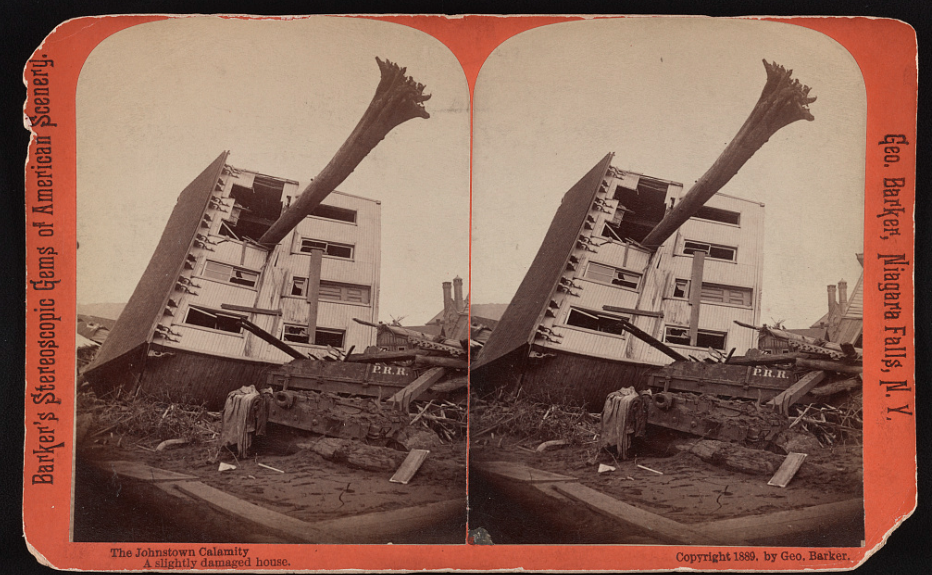
Besides Sheetz, which is a staple across not only Pennsylvania, but also Ohio and West Virginia, Johnstown is mostly famous for the great Johnstown Floods, the first of which was in late May of 1889. Situated in a valley below man-made Conemaugh Lake and its retaining wall, the South Fork Dam, Johnstown filled up like a bathtub when the levees burst. After days of the heaviest rainfall ever seen in Western PA, the South Fork Dam was breached, and all 3.843 billion gallons of Conemaugh Lake, full literally to the brim, came bearing down upon the townspeople.
The city simply washed away. Houses, factories, any soil above bedrock, was all swept down the valley. The flood of debris met Stone Bridge, a railway viaduct that spans the Conemaugh river on Johnstown’s north side, finished only a year earlier in 1888 and which still stands to this day. The bridge held. Wreckage piled up against its face, forming a barricade which promptly caught fire. The wave hit and bounced back against the town from the other direction. Then the water settled and then stayed, in a perverse imitation of the now empty Conemaugh Lake.
The first Johnstown flood killed over two thousand people, a disaster death toll only surpassed in America by 1900’s Galveston hurricane, and later, the 9/11 attacks. Bodies were carried as far as Cincinnati. The fire on the bridge took three days to put out. When the floodwaters receded, the debris piled over seventy feet high and thirty acres across. After months of effort, workers clearing the mountain of wreckage had to resort to blasting it apart with dynamite, in part because the flood swept away the Cambria Iron Works, a manufacturer of barbed wire, which had entangled the detritus in a huge metal net.
Debate raged about where blame lay for the accident. The dam was owned by the South Fork Hunting and Fishing club, the managing organization of an exclusive getaway for Pittsburgh’s elite: captains of industry such as Andrew Carnegie, Henry Clay Frick, Andrew Mellon, and other national figures and company executives. The club both modified and failed to maintain the already derelict dam. They patched holes with straw and mud, removed drainage pipes, obstructed the spillway with gratings, and lowered the height by three feet. The changes were largely made to prevent fish from escaping, except for the lowering of the dam itself, which was for ease of vehicle access.
The American Society of Civil Engineers (“ASCE”) assessed the dam after the flood, but the game was seemingly rigged from the start. The ASCE had ties to the club. ASCE President William Shinn was fast friends with Andrew Carnegie. The investigation head, railroad engineer Max Becker, was deeply intertwined with club member and Pennsylvania Railroad executive Robert Pitcairn. When the report was released in mid-1891, a full year-and-a-half after it had been completed, it exonerated the club. The flood was not their fault.
***
At the time, what occurred behind closed doors in ASCE meetings was a black box. But something was clearly off. Wild speculation mixed violently with public outrage. Spectators and observers plainly saw the slipshod condition of the dam, and newspapers seized the story, blowing it into a national issue. Courts reacted by modifying their precedent. The country was determined that a man-made disaster as large as the Johnstown flood would never occur again — at least without the buck stopping where it ought to.
Before the flood, the US had used a fault-based system of liability to determine claims of wrongdoing. In order to get payout for injury, you had to prove negligence, recklessness, knowledge, or purpose on the part of your transgressor. Nowadays, if your fishing crew kills over 2000 people in the name of game, you’re much more likely to be paid regardless of the surrounding circumstances.
In many ways, Johnstown is the birthplace of modern insurance practices. Gone is the time of powerful people manipulating social reality and the justice system to avoid paying. Now, They’ve got you, sucker!, hook line and sinker. You’re shelling out, and it’s up to you and your insurance company (which you have, just in case you accidentally give a bunch of people cancer, or kill them in a flood), to hash it out in litigation.
Still, it didn’t stop the second Johnstown flood. Or the third one. Once-in-a-Thousand-Years rainstorms appear to happen about twice a century in the Conemaugh valley. While we ride up and down the rolling hills on the way to Indian Lake, Tom recounts the disastrous 1977 flood and the “piss-poor” rescue efforts. The town’s population never recovered, down 15% from the ’70s high. Crime is a large problem on the West side of town, where the “Ghetto Sheetz” is located, a phrase widely and gleefully repeated by Tom’s four siblings. To Ghetto Sheetz’s credit, it is largely indistinguishable from the other two. You will still be served completely adequate mozzarella sticks and “surprisingly good” coffee — Sam’s glowing review.
Regardless, the rural convenience store landscape cannot help but seethe with inferiority to the downright bucolic Indian Lake. Tom’s family has a veritable compound on its peaceful shores. Twin sprawling cabins; two racket-sport courts which can be switched for pickleball from badminton and combined for basketball; pontoon, speed, and paddle boats; plenty of parking to boot. Thank goodness for the amenities and the space, because there is extended family to match.
Over twenty relatives are in attendance for Sunday dinner. I never learn all their names. Tom’s dad has many sisters and brothers, each with children of their own. There is a flutter of significant others, adoptees, family friends, staff-come-friends, neighbors, and two dogs, which are not their dogs, but that somehow make it on to the boat, already riding low with teens, for tubing.
This is a classic Memorial Day activity I am told. I am a tubing virgin, ready to have my cherry popped. There is good reason for my innocence though. My lips are allergic to some ingredient in sunscreen, which causes them to flake and become hyper-sensitive, terribly inconvenient because of my already albino-adjacent complexion. I learned this the hard way during a miserable high-school summer of caddying. By the end of the 18th, my entire mouth would have a ring of raw skin around it, making me look sort of like Homer Simpson if you replaced his khaki beard with rotting flesh, so I tend to stay away from outdoor, high-wind, high-sun activities likely to chap. Today, I also make the mistake of forgoing sunscreen altogether.
Several times I am asked what my usual Memorial Day plans are, and I come up blank. Somehow the holiday has completely passed me by in years previous. There are no beach trips, no get-togethers. It is wonderful, then, that I should be generously included in this weekend. But after the time on the water, I am redder than a lobster, and need to cool down inside and apply aloe.
How disappointed would the members of the South Fork Fishing and Hunting club be, to discover that their secluded retreats once reserved for the dignified activity of taking the lives of lesser animals, have been democratized and degraded into hosting jet-ski yahoos. We are competing for space on the water with several of these craft that go zipping by. The tube, not a donut-shaped rubber inner tube one might use for what I am corrected into calling “lazy river,” but instead a large flat bladder covered in a thick weave of nylon and affixed with three sets of handles, is attached to the boat’s roll bar with a long rope. I have nightmare scenarios in my head of losing my grip, and being flung with centrifugal force, directly into the path of one of the jet-skis. Accordingly, I hold on with iron strength. My knuckles are white with terror, and the frigid water (still uncomfortably cool in late spring) reduces blood flow to a minimum, making the ensuing rounds of pickleball much more difficult. All the same, it’s a terrific amount of fun. I don’t think even Andrew Carnegie could refuse being towed behind a boat at 30 knots, and jumping the wake to catch some serious, stomach-rising air.
I am even less familiar with pickleball. The name begs an obvious question whose answer, I am sorry to report, is exceedingly stupid. “Pickle” appears to be a WASPian shorthand for leftover parts, a loan word from the sport of rowing where a “Pickle Boat” is composed of the benched rowers who don’t make the cut for the principal boat. Fittingly, pickleball, a game played with a wiffle ball and ping-pong paddles on a low-netted badminton court, with nearly the rules of doubles tennis and the no-go-zone of shuffleboard, is a bit of a bastard child and as a result has a bit of a bastard name. It truly is the sample platter of country club activities.
I am given five or six plausible but incorrect folk etymologies before someone gets the gall to actually google it. These range from the bright green color of the wiffle ball (not quite pickle-shaded) to an association of pickle from “the Kitchen” (the no-volley strip of area directly in front of the net), to a riff on Pickles, the name of a dog owned by Washington State Politician Joel Pritchard, the man who invented the game. Tom’s kid cousin, blinking earnestly like a wide-eyed cat from behind a pair of thick glasses, suggests that it is because of how pickles bounce when they are thrown, much like the wiffle ball. We do not test this theory. The kid is cute, cheering indiscriminately for both teams from the back deck of cabin #1, which overlooks the courts and the lake. The younger adults rile him up by taking fake offense to this Benedict Arnold level of traitorism. “Go Tom! No — go Mary!”
When we sit down for dinner there isn’t a divide between kid and adult tables (although the truly little kids eat earlier); more of an inner and outer sanctum. At dinner, the adults and one or two chosen grandchildren cluster around the silent patriarch of the family at a small circular table. This man is Grandfather, Tom’s father’s father. I don’t know where his wife is, the subject does not arise, but I suspect she may be long gone because Tom’s grandfather is old, very old: late into his 90s. He’s also senile, bordering on incoherent. George, one of Tom’s siblings, attends to him throughout the day. Over the span of ten minutes, Grandfather is reminded about twenty times of various logistics and relational points: how he got here (driven, by his son), where his son is (“Your son is right behind you on the grill”), when they will go home (in about three hours), and how he will get back (driven, by his son). I never see Grandfather ask any of these questions, but George repeats the answers sweetly, in an unburdened voice. It is clear that he is a beloved figure in the family, and it is no great effort to spend time with him or help him out, and he is quite content.
This comes as a pleasant surprise to me. The elderly in my family are violently sharp, manipulative, and intensely irritating. They hardly ever seem happy or needless. Grandfather, on the other hand, has a doting collection of relatives to keep him occupied. The adults play cards with him and refresh him on the rules. The girls sit and chat with him while husking corn and laugh when he makes quiet jokes. Two women who collectively go by the Aunts (pronounced “Ants”) regale me with stories about their father’s younger years, when he would run errands in town and stop to talk to the female bank tellers, the hardware store manager, and the owner of the local pizza joint who would give him a free slice. “That’s good pie, you would say.” The Aunts laugh, as they tell his own stories to Grandfather who smiles and nods along. I don’t see the telltale flash of recognition in his eye. “It took you hours to pick up a hammer! Sometimes I think you would just come out here to the cabin and sit alone,” says one of the Aunts. “He would, he would!” the other confirms with a bit of childlike glee. George describes him to me as “a classic gentleman.”
Tom’s father runs a regional business inherited from this man, one which manufactures powder-coated steel tanks and other metal products. By most any metric, but especially for rural Pennsylvania, they’ve become quite wealthy. This oasis on the lake is made possible by him and maintained by his family. There may not be a debt per say, any more than someone is inherently indebted to a parent for the life and nurture that they ideally ought to provide to their kid as a responsible steward of their own legacy, but Grandfather is clearly being paid back by a grateful family. And yet, it strikes me that they too are benefiting enormously from his presence. Being reminded of their childhood, enjoying their time together as a large clan as only a clan can. They’re keeping his memory alive, even though he’s still around. Together, the family forms a sort of net, or a pyramidic temple to his glorification. Grandfather is here in one way, gone in another, and right back where he was all at the same time. As opposed to him living vicariously through his offspring, they’re living backwards through him.
As I crawl into the lower bunk of Tom’s second brother Paul’s bed that night (with Sam on top after a brief argument), I am suddenly very sad. My family is miles away in the Midwest, but I am closer to them here in PA than I have been in DC for nearly nine months, ever since I moved. I do not cry, but I am beginning to realize that I may have enjoyed something truly personal and special for the last time.
***
On the second day, we stop by Sheetz again, and then head somewhere else before going to the lake house: Flight 93. Mary has been wanting to see it “forever,” I’m told. I didn’t even know it was here. But sure enough, after a bit of wiki-diving, it pops up. The fourth plane of the September Eleventh Attacks crashed in the open field of a converted coal strip-mine literally a stone’s throw away from Indian Lake. Much to Tom’s chagrin, we also pass directly next to his family’s plant, with a very memeable sign outside, and Sam and I clamor for him to pull over and take a group photo. He does so, but it also takes Mary’s nudging to get him out of the car and stand there with us, stone faced. After this side bar, we are off.
I have no idea what to expect. Our quad of associates is composed of 2000s kids. I am the eldest at 23. In September of 2001 we were all barely over a year old. It was a common shit-test in middle and high school to see if anyone claimed they could remember 9/11. If they could, that kid was a lying SOB, and not to be trusted or invited over to play PS4. The attacks were obviously a horrible tragedy, but that couldn’t prevent 9/11 from being the butt of every other joke. If humor is tragedy plus time, a tragedy you did not witness and cannot remember is automatically funny. The gravity of the situation did not stop my Midwest friends and I from saying “happy 9/11” to each other on the nominative date every year. It did not stop the same friends, on a visit to DC, from making their eyes really big every time a plane would fly behind the Washington Monument, and with alleged depth-less monoscopic vision yell, “Wow, that plane is flying really close to — Oh my God!” and then start laughing like hyenas.
Part of this is a fuck you, bite me attitude towards the whole US of A. While we don’t remember the attacks, we do remember Afghanistan, which now, from the perspective of 2023, can largely be described as a wash. Among liberal, liberal arts school students, it’s probably closer to a series of war crimes and wakes at public parks in our hometowns. Few if any of us were caught up in the initial wave of islamophobia, just the ensuing roll-back of polite respect for different cultures and videos of ignorant white people trying to get Sikhs in turbans pulled off planes. The whole thing is very abstract, very far away. The parts that are close are our government’s doing.
Another, even larger factor, is the sheer amount of viral media online that satirizes, critically dismantles, cynically analyzes, and shocks users with 9/11 content. “Now watch this drive,” Dubya says as he hits a pinging golf ball that merges seamlessly into a plane striking the South tower. It is, unfortunately, hilarious. The people in charge are so plainly moronic, incompetent, and evil in all the ways that really matter, the human ways, that nobody our age who’s been around the block once or twice even bats an eye anymore at a whack job conspiracy theory. There are too many four-hour YouTube vids, too many leaked CIA reports, too many photos of weird guys next to vans on top of parking structures with cameras. Everyone’s had a phase or known someone who had a phase of disappearing up the internet’s ass and emerging a month later looking ragged. Some people get over it. Some don’t. We’re all a little jaded for “the truth is out there.” Sure, but do you want to dig through the shit?
Most people seemed to have landed someplace reasonable. Everything happened. Jet fuel melts steel beams. If anyone starts talking about building five or the Pentagon or the Clintons, you take a sip of your beer and say “Hey, I don’t know man.” But more than a few people have a little pulsating asterisk next to their mainstream take. Usually, it’s that somebody knew. Maybe an agency, maybe another country. Sometimes it’s twisted up with the Patriot Act, or airport security theater, or the war in Afghanistan, or Bin Laden, or the Saudis, or the LIV golf merger, or the commission, or Kissinger — but the uncomfortable, underlying sentiment, like a weird vibration putting your teeth on edge, is that it just doesn’t feel right. Not right as in not morally wrong, but right as in the kids aren’t alright. Like, you woke up one morning and the milk of human kindness had turned sour and stayed that way. There is no conspiracy distorting reality. The reality is just bad.
It seemed like they really took a shot at it in the ’90s. Sincerely, with boldfaced naivete as the sun rose in East Germany and set on Germany, and the Soviets dried up, and gracious America flung open her doors and pocketbook to the world, maybe we thought that this was it, the final suture on the wounded terror of the 20th century. It does really feel like somebody, maybe even us, tried to shoot for the moon, and were mired among the stars. But the scholastic utopia emblazoned upon the walls of our elementary schools, a mural with all the world’s children holding hands, was gone before we started kindergarten, even if the paint was still on the cinder blocks. And history grinds on.
The memorial, ironically, puts me in mind of a dam. It’s a set of two huge, gray, totally smooth parallel walls with a museum tucked in between them. The memorial sits on top of a hill overlooking the crash site. The hill is at first a plateau and then dips down, causing the wall to appear larger and higher on its left side. On that same side, the wall is interrupted with a vertical slice of sky to form a gateway to the metal and glass lookout, a spike jutting into the air.
It’s totally surreal, this huge brutalist slab nestled into the hills. It looks like an alien spaceship that didn't crash-land so much as sink straight down into the earth. Hushed tones echo between the walls as people stop to look at plaques and gaze out onto the site. Everyone is eminently respectful, and very quiet. A hoard of overweight children in flip flops jostle each other noiselessly on their way to the lookout tip. An aging biker gang somewhere in between mid-life crisis and OG Hells Angels groupies stand somberly against the wall. Despite being in the shade, they are all wearing wrap-around sunglasses and full spiky biker regalia which at this point is so cliche it’s not really surprising or offensive at all. One of them is smoking a cigarette, and I try to delay long enough to watch the National Parks employee, still wearing a ranger hat despite being range-less, rip him a new one, but my group moves on before she reaches him.
The crowd is atomized and aimless. People bounce into and out of the museum like pool balls gliding around a felt table. Nobody seems to be reading or taking a long look at anything. If they’re trying to learn about the history of Flight 93, the technique of choice must be osmosis. Everyone just seems to be taking it all in, the atmosphere, the gravity of the huge wall.
We navigate to the end of the lookout point, brushing by I kid you not an actual convent of nuns, and gaze down. It is exactly as expected, an empty field encircled by a path. The boulder marking the crash spot is so small I almost don’t even see it. A child is holding a flat spiral lollipop. Etched into the glass are the pair of sentences “A common field one day. A field of honor forever.” Not quite as catchy as Never Forget.
I can’t decide how this place makes me feel. Part of me wants to burst out laughing, another wants to weep. Thunderhead clouds cluster the horizon but something is holding them at bay.
We don’t go into the museum. Everyone is tired, and we’ve all been to the one in New York. We know the schtick, where you get to hear the phone calls of the people on the planes. They’re terrifying, and nobody really wants to hear them again. It’s the sounds of lots of people who know they’re going to die very soon, and a few people bum-rushing the cabin door with a drinks cart, and then the crashing of a plane. So, we just head for the exit through the walls that feel like they’re closing in. We get back in the car. I relax a breath in my chest that I didn’t know I was holding. Everyone readjusts and does a little stretch. We drive off the mound, and as we pass Tom’s dad’s factory, this time going the other way, he tells us a story.
Apparently, some guys who worked there actually saw the incident. As far as I know, only one guy has ever publicly claimed to have seen the flight go down, but Tom says that these guys on the factory floor saw it too, while they were out of the building on a smoke break. In my mind, they’re standing out there, still reeling from what they were just watching on TV for the past 40 minutes, one plane, and then another, striking the World Trade Center towers one and two, quintessential icons of the largest city in the most powerful country in the world, and arguably the hub of perfect, crystal, global capitalism, each of them then taking long alternating pulls of their cigarettes when they look up just in time to watch a third behemoth of a plane gliding overhead silently flip upside down in the sky and hang weightless at its apex, blocking out the sun, whereupon, screaming, it dopplers down with increasing intensity and a rush of sound shakes the windows as the fiery cloud blossoms on the horizon.
At least that’s how I imagine it.
It’s hard to know which way is up out here in the hills of Pennsylvania. We zip by little Flight 93 chapels and homespun monuments to the victims. The South Fork Hunting Lodge is now a memorial for the flood. You couldn’t find a more reality-based community than this, except when the plane of their reality intersects with the plane of the geopolitical reality. In the hinterlands of an empire, one which has been mined out, smoked out, leveled, raised, razed, burned, and left to heal until the next time, I am wondering why it is exactly that we have to sacrifice a lamb in order to stop the bloodshed. I whip out my phone in order to confirm if the Sheetz (Sheetzs? Sheetzes?) collectively form a pentagram, but the answer is too easy: they merely follow the path of the valley.
I’m not going to bore you with the 9/11 commission story. You’ve heard it all before, and I haven’t gotten deeper than the Wikipedia page anyway. Who really knows. It doesn’t even seem worth thinking about, to be honest. But when did it become like this? When did it become more work to forget than to remember?
***
I’m practically nonverbal the rest of the day. I recuse myself to the upstairs deck to watch the family play pickleball while I study for the LSAT. The logic games section is yielding before me in fun and unexpected ways, but they’re still my weakest link. The crowd of athletes gets tired and gradually joins me at the table, so I push my work aside and begin to set the places for dinner. Talk slowly oozes out of me as we socialize. I’m beginning to feel a little more human at last.
Memorial Day weekend is winding up. The last thing we do before heading out is play the obligatory game of vintage electronic Catchphrase: the black and red 2013 version, not the silver and blue 2000 version, or else I’d really be hopeless. The adults have a definite timeline advantage, and even though they’re not as sharp and “didn’t go to fancy colleges” (repeated several times throughout the visit, possibly from a place of insecurity, possibly from pride (who cares, we’re all friends here, right?)), they absolutely cream us. Grandfather is still up, and asks which team he’s on, and is told probably nobody’s. He seems to accept this and leans back, content. It additionally doesn’t help that Tom and I are distracted by literal children’s toys, some sets of interconnected right-angle triangular prisms, two of which make a cube, and of which twenty or so then extend into a line that bends pleasingly. Both of us are feverishly trying to figure out how to turn it into a sphere-approximate, but fail. Night falls after a long day, and we depart, stopping, of course, at Sheetz on the way back.
As I write this, I am sitting in the Johnstown airport for the 9 AM flight back to Washington, DC. The Johnstown airport is actually really charming. It’s one large room with all the trappings of a normal airport. There’s a Hertz rental stall (and presumably a lot somewhere out back), a check-in desk for United, the only airline that services Johnstown, a small bar, a metal detector and Leidos carry-on X-ray machine staffed by two TSA agents, and a single baggage claim carousel emerging from the wall with the classic black double-thick vinyl draft curtains that are all that’s keeping this room separate from the tarmac. On my life, I have owned this exact airport as a Playmobil set in my childhood. It feels like a toy, or a one room schoolhouse, or something in between.
Hanging from the ceiling are models of World War II planes, and the da Vinci glider, and the Wright Flyer. The glass cabinets are littered with war memorabilia bordering on junk. Some framed photos of Air Force One are up on the wall, with accompanying signed headshots of Joe & the Don, each having swung by Johnstown to visit Flight 93 on the 2020 campaign trail. But the thing that actually catches my eye is the sign that says “Johnstown Cambria County Airport.” I have a case in the firm drive under the name Cambria County, back at work. We actually have lots of cases in PA, and I think for a second that it’s an asbestos case, but I take out my laptop to look it up, and it’s not. It’s about a guy named Kevin Siehl.
***
On July 14th, 1991, police found Kevin’s estranged wife, Christine Siehl, dead in her bathtub with blood everywhere and the shower running. Estimated time of death was between 11 PM July 12th, and 3-4 AM July 14th. There were signs of a struggle: broken mirror, kitty litter strewn around the house, yet no evidence of forced entry. Police picked up a fingerprint matching Kevin’s at the scene, confiscated his tennis shoes and then discovered glass and cat excrement in the soles. It was open and shut. Kevin went to jail for life.
Yet in 2016, he was released. It came to light that a second round of analysis on Kevin’s shoes found no glass and no cat excrement, but that this was concealed from the jury. The fingerprint was never lifted or tested in a lab, just eyeballed. Kevin’s own defense attorney, later a Cambria County Judge, failed to have any of this challenged or verified by an outside defense expert. He even personally knew that the science was phony.
Kevin was released after 25 years in jail, and promptly sued Johnstown and its police department, Cambria County, the state troopers, the assistant DA, the forensic scientists, and the arresting officer. In his complaint, he says that his own countrymen set him up, and conspired to get him locked up without evidence. He also says that they ignored two other suspects: Frank Wills, Christine’s lover, and Kevin Siehl’s nephew, Robert Prebehalla.
Robert had previously threatened to kill Christine if she ever hurt Kevin. And after the murder, Robert was brought to police HQ where he spent a night shaking like a sick dog and saying that he was going to go to jail. He then refused two separate polygraph tests. When the body was found, he called his girlfriend and said he was going to be arrested for murdering someone and that she should tell people he had been in Pittsburgh the night of the 12th.
At the original trial, Robert testified that he had given Kevin $80 to go buy him some cocaine. When Kevin didn’t show, Robert went looking for him, and found him at 11 PM “trashed, high on cocaine and drunk” outside of the hospital where Christine worked as a nurse. The next day, Kevin apparently punched Robert in the face and said that his wife was dead and that Robert had killed her. Kevin didn’t take the stand to contest any of the testimony.
Regardless, in the civil case against Kevin’s conspirators, who put him in jail with insufficient evidence, Kevin was awarded $8.2 million. The insurance companies all squabbled amongst each other to avoid paying. But in the very end, it was Kevin’s son, the one he had with Christine, Kevin C. Siehl II, who was given the money. Kevin Sr. had died earlier that year. Robert died in 2021.
So, what’s the point? That it doesn’t matter who killed Christine Siehl? That it doesn’t matter if justice got done or undone or redone? That the line between innocent and guilty, fault and no-fault, is just a meaningless social construct, and Foucault should be able to fuck as many little Tunisian boys as he wants? Or is there something to be said about repentance, and change, and getting six years of free air before you finally bite it?
Something about new beginnings, I think, as we stand in the ten-person line for security. Every time someone closes a door, it’s just a door that you can re-open. Just a bunch of hominids standing around, opening and closing a door, building and breaking the walls of the house, sometimes doing it wrong, sometimes doing it right, because it’s hard, and we can’t really know when it’s going to rain or pour.
There’s a knife on my keychain that never gets found going through TSA. That’s because it’s shaped like a key. I consider throwing it into the trash right there, just in case it does get found this time, but I don’t, and it doesn’t, and I go through the metal detector without even having to take my belt off.
As we board, the gate agent brags about the plane: a CRJ 200, allegedly the smallest in the United Express Fleet. This is contradicted by the inflight magazine however, which shows that the actual smallest plane is the ES-30, a little thirty-person electric thing (something that’s new to me, given that I always thought the batteries were too heavy), but it’s not clear if it’s in production yet. I switch my phone into airplane mode. Sam settles into his book, and as we advance down the runway, engines blasting, slowly sliding into the air, I stifle a laugh. While rooting around in my bag, I find a slip of paper. It’s something my buds in DC made, a gag invite for Henry Kissinger’s 100th Birthday Bash, and the old man stares up from the black and white photo, boggle-eyed.
BYO Nobel Peace Prize.
-- G. Bakersfield is an American interested in law, society, and infrastructure.