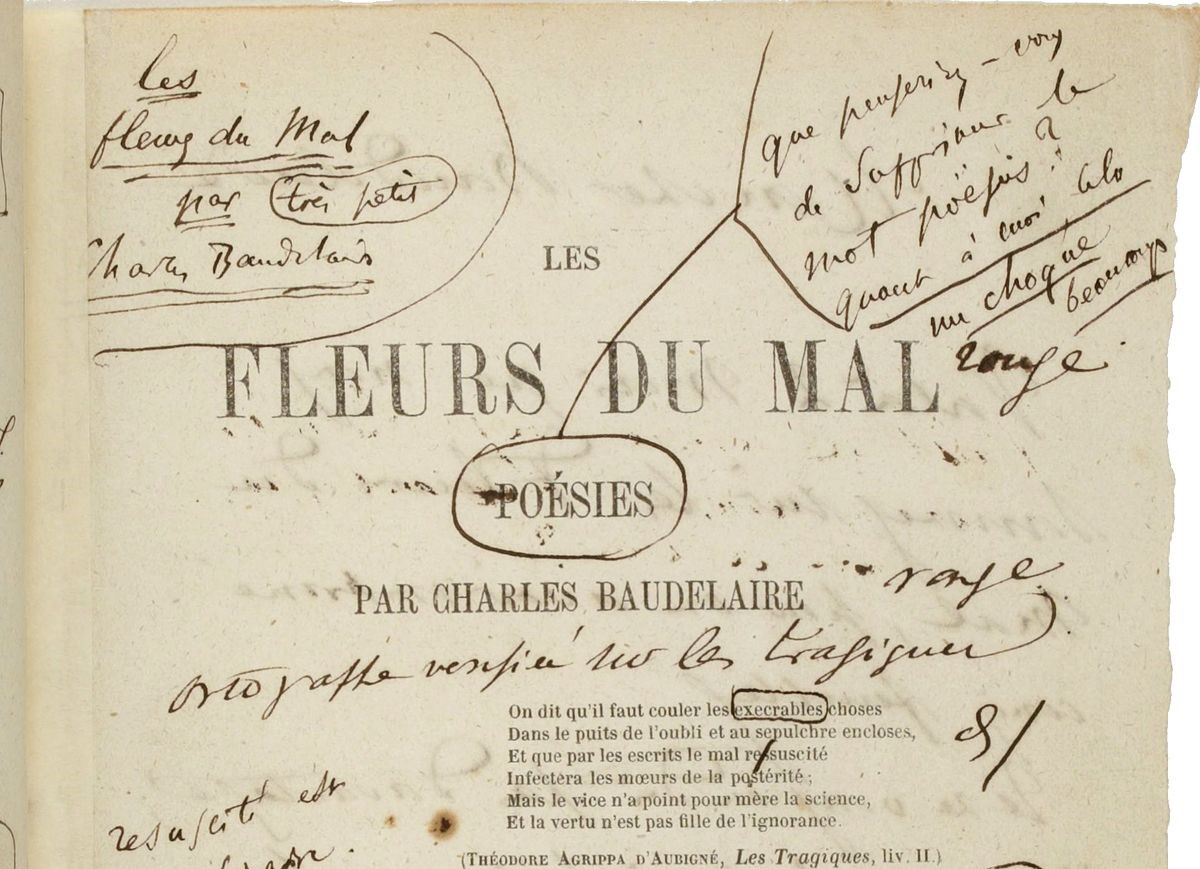
These bits and pieces are translated from the ‘Projets et Notes’ in Oeuvres Posthumes (Paris, 1908), pp. 406–12, and the ‘Notes et Fragments Divers’ in Juvenilia: Oeuvres Posthumes: Reliquiae (Paris, 1952), pp. 133–43, all gathered posthumously from Baudelaire’s notebooks. Many writers have sent carefully, deliberately fashioned and polished ‘notes’ or ‘fragments’ to the press. Many, realizing they have not the talent or care to fashion and polish, send half-finished work to press under one of these defensive and apologetic titles. But what follow are genuine notes and fragments. Scenes of romanticized autobiography fade into outlines of unwritten novels which fade into sketches of characters (or of the human character) which fade into names and addresses of women (prostitutes?). I do not suppose Baudelaire intended any of them, at least in the form in which they survive, for any other eye than his own. The first ‘translation,’ then, was the initial preparation for press.
CHILDHOOD:
Old Louis XVI furniture, antiques, the Consulate, pastels, eighteenth-century society.
After 1830, college in Lyon, coups, battles with professors and comrades, heavy depressions.
Return to Paris, college and education by my stepfather.
YOUTH:
Expulsion from Louis le Grand, the story of the baccalaureate.
Travels with my stepfather in the Pyrénées.
Life of freedom in Paris, first literary encounters: Ourliac, Gérard, Balzac, Levavasseur, Delatouche.
Travels in India: first adventure, vessel unmasted; Mauritius, Île Bourbon, Malabar, Ceylon, Hindoostan, the Cape; happy wandering.
Second adventure: return trip on a vessel without provisions and taking on water.
Return to Paris; second literary encounters: Sainte-Beuve, Hugo, Gautier, Esquiros.
Long struggle to make myself known to the editor of some journal or other.
Taste, permanent since childhood, for all kinds of sculptural representation.
Simultaneous preoccupations with philosophy and with the beauties of prose and verse; with the perpetual, mutual attachment of ideal and life.
The Starving Pauper. — Imagine a starving pauper who wants to enjoy a public festival where provisions are distributed so he can eat. He is jostled and knocked unconscious by the crowd.
The Almanack. — Make a speculative investment on the basis of a calculation of probability regarding stamped letters that do not arrive and the compensation these incur.
The Parricide Love. — Picture an inn. Woman, husband, father of the husband. Lovers, the whole town, including the Imperial Prosecutor.
Reason for the woman’s hatred of the father.
Jealousy of the husband. Murder, trial, execution.
The Automaton. — How he is as a lover.
Sorcerer, foreseeing misfortune, tries to struggle against the laws of nature. His last will and testament: ‘If you really love me…’ And he returns to life automatically. His mistress wonders which of the two lives is a dream. The automaton, inhabited by the soul, persuades her that she was dreaming before and that now he is really alive.
But the soul, blushing to have found happiness in a lie, would rather commit murder, and awakens his lover in death, to tell her everything in Paradise.
What is Paradise?
Jeanne and the Automaton.
Old gentleman-caller. — Every kind of libertinism.
The grammatical dance.
The voice of the adjective penetrates me to the bone.
A is a libertine.
A is a libertine no longer.
A dies not a libertine.
A becomes a libertine.
The frigid wife becomes the hot lover of a dead man.
No doubt in certain moments of delirium I lavished him with very lively caresses: for he told me many times that he would never have suspected so many diabolical errors in love of an honest woman, still less of a philosopher.
Voice of Paradise.
The nub of the thing is the drama of the Revolution.
The style becomes more decent as the ideas become less decent.
Which becomes the mysterious touch.
There is an indecency in slenderness that makes it charming.
The End of the World. — A novel about the last men. — The same vices as ever. — Immense distances. — About war, marriage, politics among the last men.
The world’s last palpitations, struggles, rivalries. Hatred. Taste for destruction and for propriety. Love among mankind’s decrepitude. Every king has no more than fifty armed men.
The Reasonable Fool and the Beautiful Adventuress. — Sensual pleasure in the company of eccentrics.
What horror and what pleasure in the love for a spy-girl, a robber-girl, etc.! The moral reason for this pleasure.
One must always return to Sade, that is, to natural man, to explain evil. Begin with a conversation about love between difficult individuals.
Monstrous feelings of friendship or admiration for a vicious woman.
Follow horrible, strange adventures through capital cities.
The Beautiful Adventuress. — Novel rather than poem.
The Virgin Mistress. — The woman you do not toy with is the one you love.
Aesthetic delicacy, idolatrous tribute by the bored.
What makes the mistress more darling is her debauchery with other women. What she loses of sensual pleasure she gains in adoration. Consciousness of needing his pardon makes the man more likeable. About chastity in love.
Heads or Tails. — Having uncovered a conspiracy. — It is almost an invention. — It is a novel I want an end for. — I use the Empire. — Alternative, hesitation. — Why save the Empire? Why destroy it? — Therefore, ‘heads or tails.’
A COMEDY PERHAPS.
The Fatal Portrait. — Analytic method to verify miracle. Portrait of the deceased. Discovery of a last will and testament. Picture a family marked by fatal sadness.
The Malagasy Pretender. — Find a copy of Le Monde Illustré. — See Messrs. Reynaud, Pothey and Delvau, 9 Rue Véron.
Man who believes his dog or his cat is the Devil or some trapped spirit.
Man who sees an imaginary fault, vice (physical?) in his mistress. Obsession.
Man who thinks himself ugly, or who sees an imaginary vice (physical?) in himself. Obsession.
Man desperate not to be as beautiful as his wife.
One who is not beautiful cannot enjoy love.
Consider the question of Sultana Alida.
The Honours-Fair. — Gazette des Tribunaux, 30 September 1853, Mr. Ducreux, substitute.
Series of scenes from the Directory and Consulate.
Fashions of those eras.
Indecent engravings of those eras.
Montesquieu’s style.
Pleasures of the Church. Libertine impressions registered in St. Paul’s.
A little old lady whom we follow.
Gallery of statues or paintings for the new Don Juan.
Theory of faith.
Apply to joy, to feeling oneself alive, the idea of the hyperacuity of the senses applied by Poe to pain. Make an invention by means of pure logic of inversion. The path is already beaten, backwards.
Neither remorse nor regret.
What matter to have suffered much when one has enjoyed much?
It is a law, an equilibrium.
Find the moral algebra of this dictum.
Varied refrains.
Write to Malassis to ask him for books on highwaymen, brigands, sorcerers, especially since the Revolutionary era.
Vendée
Schinderhannes
Brigands
Sorcery
Kidnappings
Palaces and prisons (subterranean)
And tortures and horrors!
Very young, petticoats, silk, perfumes, ladies’ knees.
Love of perfection. All that disgusts him he destroys.
He finds an excuse.
Find the ending by means of analysis.
Penetrate the meaning (vague and general) of colors.
Divisions and subdivisions.
The voluptuary, having long wavered, is drawn from ferocity into charity. What kind of misfortune might bring about his conversion? The illness of his former accomplice. Struggle between egoism, pity and remorse. His mistress (become his daughter) allows him to know fatherly feelings. — Remorse: — who is to say he is not the author of the illness?
Oceanic rhetoric.
False rhetoric.
True rhetoric.
The vertigo one feels in great cities is like the vertigo one undergoes in nature's midst. — Delicacies of chaos and immensity. — Feeling of a sensitive man visiting a great unknown city.
Scorpion-man.
Torture by sleight-of-hand.
Paradox of almsgiving.
For gatherings, ornaments and décors.
Vague poetic color.
But nevertheless:
Revolution
Directory
Empire
Restoration.
I am an old man:
My taste in dress
Fashions
Furnishings
Women.
Salvation is in the good moments. Salvation is money, fame, security, the suspension of the Conseil Judiciaire, life with Jeanne.
Drooping shirt
Low and fat throat
Moral suggestions above all
General sadness
Messalina’s shoulder
Sinister, macabre dolls.
Be the greatest of men. Tell yourself this at every moment.
To have the material is to have the money.
AGATHE.
Coiffed as if a child, curled and tumbling down the back.
Face made up. Eyebrows, eyelids, lips. Red, white, beauty-spots.
Earrings, necklaces, bracelets, rings.
Deep-necked dress, nude arms. No crinoline.
Very fine silk stockings, the very latest, black if the dress is black or brown. Pink if the dress is clear. Very revealing slippers. Garters for gallantry.
A bath. Feet and hands very doted upon. General perfumery.
Leaving the ball because of the coiffure, hooded if we are going outside.
White sheets. My letter.
Adèle. Adèle. Adèle.
Dishonest woman
Innocent face ×
Happy chatting
Coelina Arbel
Agathe
Adrienne
Aline Lorin ×Adèle
Mrs. Guichardet ×Garibaldi ×
Bathilde ×
Johanna ×
Mulatta ×
Effea
Blondblond
Louise’s girlfriend
Anna 36 Rue Pigale|
Mrs. Migne 37 Rue St.-Marc
Rosa 18 St.-Lazare
Bathing and washing
Bathtub
Undressing
Gabrielle 17 Neuve-Bréda
Anna 36 Pigale
Marguerite Bellegarde 50 Malesherbes
Rachel 20 Cadet
Keller 18 Chaussée-d’Antin
Henriette 9 St.-Nicolas
Judith 16 Trévise
Louise de Gréan 50 Clichy
Veiled eye
Deception
Mrs. Guichardet
Blanche 15 Rue N.-Bréda
Fanny 10 Rue Joubert
Mathilde 286 Rue St.-H
Mrs. Coron Cité-d’Antin 6
Henriette Faub. Poissonière 1 bis
Rue de la Ferme des Mathurins
Clémence Dupuis 22, Passage Saunier
-- Fergus Cullen is an apprentice historian and dilettante in various arts.