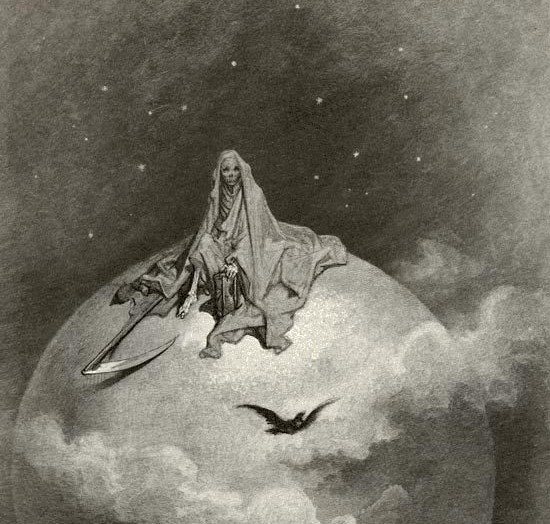
I had long stopped asking myself why I was here. I stepped into the room carrying five thimble-sized cups of tea on a large saucer, careful not to rattle it, mindful of the surface tension, gaze fixed forever forward. I set the saucer down for the ancient man, thin and wearing a white beard and the same threadbare garment as always. He continued to recline, not sensing my disturbance in the room, unmoving in his leather armchair, goggles over his eyes as usual. Just as any other day, he was holding his soup spoon.
I’d been told he didn’t like his tea piping hot, that room temperature would be fine, and so I never questioned it. The thimbles were my own adaptation, allowing the liquid to cool quickly on the long walk down the corridor to his chambers. One tiny cup, five times a day, brought all at once to decrease the chances of another eruption of his volcanic disposition. To his left at about table height was a curved screen made of plasma that spanned the width of the room. In it were countless planets and galaxies swirling in place, everything that ever was or ever would be was there, perfectly arranged and intricate in detail like tiny clocks. The screen centered on our own planet as orbital clouds gently wafted across the screen.
I knew my job and it was simple: keep the man calm. It was my entire existential purpose. I was to appease him with offerings of tea, cookies, foot rubs, silent songs that could only be felt through the flutter of molecules spinning and colliding about the room like butterflies in migration.
This man, as old as time itself, was hardly frail. He knew everything there ever was to know about the universe, all its questions and its secrets, all their respective reasons for existing. And I admired and empathized with the man, imagining his to be a difficult position: living alone in a state of immortality with its lack of surprises had to be painfully monotonous, everything changing so gradually that it was, in essence, entirely unchanging. There was only one variable in the seemingly automatic workings of the universe and that was his temper- if it was allowed to flare, he would take his soup spoon and swipe it across the screen and scoop up puddles of planets wiping them completely off the map, flinging them to the corners of the ever-expanding universe. In this way he destroyed countless galaxies, leaving gaps of nothingness in his wake like a boat cutting through a wave of the sprawling ocean of temporality, momentarily disturbing it, making it forever change course.
Eventually that fluid in which all of life was suspended- that embryonic, primordial soup- would ooze back together, mend, sew up the gaping hole in itself and in a hundred million years a planet would form again in the seed of all that nothing. But if he got angry, he would do it again and again, waving his instrument around like some conductor of pernicion, and the tiny spinning worlds would have to start all over in their waiting for their own birth, the clock on each one restarting with no fanfare. Entropy was indifferent to all life equally, even to itself.
I gently set the cups in their places, now spinning on the side table as he continued to stay still, not noticing me, remaining deeply entranced in his meditative state, the way he spent most of his days. Neither did he acknowledge me as I walked out of the room, as I calmly floated away, each movement deliberate and soundless. It was true that I had never seen him rise from that chair; he had never spoken to me nor so much as acknowledged me. Nor have I seen him move a single muscle in his face, smooth as the liquid of a lake, despite an abundance of wrinkles.
The job was simple, I was told, but nobody said this was going to be easy. Bring him whatever he needs to keep calm, anticipate all, and make my efforts effortlessly silent. That, and look for signs that he had swiped more worlds off the map. Each day I’d make a note of the destruction and then adjust my behavior to prevent the tragedies from happening again. It was a job where one had to refrain from making mistakes, and one where you never actually knew what was a mistake, a misstep, and what wasn’t. Over time I came to believe all actions were perfect mistakes, that it was a collection of perfect accidents that made up the stuff of the whole of the universe. Therein lied my quandary and perhaps the greatest secret in the universe: for my own small personal eternity, the continuum of all those who came before me mattered not, to him we were all one and the same, his subjects, united by a singular purpose— simply to exist.
Every morning a new swipe of cosmic soup would be scooped out, gaping holes left behind for me to find as if someone had spent each night swinging a nine iron across the shifting sands of time out there in the vast emptiness of a cold, indifferent universe, trying unsuccessfully to get out of a trap of his own making moving always with the arrow of time, before giving up and sitting back down to meditate. It was a game with no winners and that was all there was. The beautifully simple purpose of the universe was merely its own answer to the question the echoing limitless void was asking itself. Each day new worlds and planets, entire galaxies and beltways of star clusters would eventually fill in those voids rippling with the boundless desire that life has for itself. The whole story tirelessly beginning again and again.
-- Svetlana Litvinchuk is a permaculturist who holds BA’s from the University of New Mexico. Her debut poetry chapbook, Only a Season (Bottlecap Features, 2024) is now available and her work has appeared or is forthcoming in Black Coffee Review, Sky Island Journal, Big Windows Review, Eunoia Review and Longhouse Press. Originally from Kyiv, Ukraine, she now lives with her husband and daughter on their organic farm in the Arkansas Ozarks.