

Customer Review

Now, how to begin when the question is I, and the answer I, delivered without punctuation. My name is Caleb Willett and my arms feel stiff and numb. I want to run around sticking pins into everyone just to see if they are normal.
It was four months ago that I first came across the collection upon which this review hinges. Letters to the Sun: The Unpublished Writings of Sirhan Sirhan, compiled anonymously and published by the wonderful team at Trineday, was released on the fourth of March, 2023, mere days after the namesake of the title was granted parole by the California Department of Corrections and Rehabilitation. On the 16th, Sirhan died of acute myeloid leukemia. An autopsy revealed the cancerous white blood cells had existed in the man’s marrow for mere months, but that which is acute trends towards closing quickly. I remember talking to some acquaintances when news of Sirhan’s death broke. We joked about the complicity of the federal government in his sudden acquiescence to the other side of mortality. Nobody noticed when a drop of blood appeared on my right arm’s ulnar side and slowly counterclockwised its way around my arrested wrist. The blood appeared even as I spoke. No needle had entered my skin.
In April, I caught wind of Letters to the Sun, and found the concept intoxicating. What the posthumous letters of a dead man famous for rendering a more significant man dead might contain… the tingling anticipation of the answer to that question set my head on fire and kept me up at night waiting for the Amazon delivery (which somehow took 3 days even with Prime) to arrive at my doorstep.
I’m a poet at heart. Someday, I hope to develop my poetry into a profession. My writing allows me to view the world as if it were all an ocean. At the beginning of 2020, scrolling through the spiderweb of camaraderie and doubt that is Twitter’s conspiracy community, I happened upon a thread arguing Sirhan Sirhan’s innocence. The account included digitized pictures of Sirhan Sirhan’s journal, which the prosecution originally submitted as evidence in the proceedings of his criminal trial. Before coming across these pictures, I had a passing interest in the assassination of RFK and had even read and written about it before in small bursts. But afterwards, the topic became one of my central concerns. Sirhan’s writing intrigued me to an almost incomprehensible degree. Oh, how hard I fell for the crafting of reality via repetition that the pictures displayed. Sirhan’s little book had about it the air of a third grader who writes in their diary that today, today, today is the day that they will dare to profess their love to their first crush. Or, perhaps more accurately, he writes with the alacrity of the baby sitting in the high chair who shouts at perfect intervals for their mother’s spoon, wanting the sweet sensation of yam on tender gums. Sirhan’s desire for murder was childish: direct, uncomplicated, and all the more powerful for that.
There are many mottos I live by; “that which does nothing says nothing” stands foremost among them. The converse - I want to do, so I say. An excerpt from Sirhan’s diary, written on May 18, 1968, reads as the following, with the original strange syntax and punctuative decisions retained:
My determination to eliminate R.F.K. is becoming more the more of an unshakeable obsession. R.F.K. must die - RFK must be killed Robert F. Kennedy must be assassinated R.F.K must be assassinated R.F.K. must be assassinated R.F.K must be assassinated R.F.K. must be assassinated RFK must be assassinated R.F.K. must be assassinated assassinated Robert F. Kennedy Robert F. Kennedy, Robert
The consensus amongst those who doubt Sirhan Sirhan’s guilt is that such messages are indicative of a wide scale operation to frame the Palestinian-American for the murder of Robert F. Kennedy. The prosecution, meanwhile, argued that such notes were representative of Sirhan’s fragile, unstable mindset in the months before the killing. His repetition implied his lack of grip on reality. It implied his guilt. I’m still unsure where I stand on Sirhan’s true role in, or responsibility for, the assassination that he rests forever in infamy associated with. But I am struck by the logic of the prosecution in introducing the man’s writing into the evidentiary record; it strikes me as the ultimate compliment. It says to Sirhan: look at your success. You have so blatantly made your desires into reality that we have no choice but to punish you for it. You have beat us at our own perverted game. I found myself, nearly a year ago, in love. Not with the violence of Sirhan’s action, but with the fervent methodology by which he manifested it. Not with the spell he cast but with his ability to cast it. Since, my poems have overflowed with repetition. People compliment me on my tenacity, my ferocity, the purposeful lack of respect I give to the act of killing. I ask: How do you say I ran out, I run out, alphabetically? In prayer, crane migration through experimental benzene? In darkrooms, old goats groaning, waiting before their court to eat? In green lights screaming go until, ago, the light turns green?
I am getting ahead of myself, off track, on track?
Finally, after a tenuous afternoon during which my package had supposedly been delivered but had yet to materialize on my doorstep, Amazon delivery no. 8-413-477 appeared, slightly water-damaged, hanging haphazardly from the first step of my apartment building’s chipped marble stairs. With the book came a generic thank you note from the publisher, and a small, blank Rosicrucian membership card, both of which I have, regrettably, since lost. I did not dive into Letters to the Sun immediately. I figured the book would make an impactful weekend escape. What I wanted was a meticulous crawl over Sirhan’s life on the support of his own clenched fists. Something entirely devoid of objectivity: idle, informed, or otherwise. A book to read with a lover and laugh at. Maybe a confession – we who whipped the winds of demonization to a flaming crescendo apologize for the wailing and gnashing of the chorus created. Many a talented author has attempted to pore over every tangible inch of evidence in the murder of Robert F. Kennedy, but none of their work has ever been deemed decisive in the court of public opinion. I cared not for yet another text delimiting the impotence of empiricism. I hoped Letters to the Sun would expand the canvas in all directions and subsequently increase its resolution, moving and bubbling in a world of informants. A text free of evidence tampering, suppression, destruction, or distortion.
Now, this is ostensibly a space for review, so I shall momentarily quench the hotspring of my autobiographical digression and analyze the foreword of Letters to the Sun on its own merits. The introductory segment, written by Robert F. Kennedy Jr., one of the foremost public champions of Sirhan’s parole effort and a controversial figure in his own right for reasons too numerous to breach, details the contents of the collection and the process through which they came to exist together as one text. While in prison, aware of his impending death, so the story goes, Sirhan shared the name of a friend with whom he had left a cache of epistolary writing that wavered between memoir, loose lyric poetry, and sharp stabs of jagged, repetitive musings crusted with an intermittently modernist, ‘60s acid-fried edge. A team of professors working under the flag of the UC system quickly located the nephew of the friend mentioned by Sirhan, who had since passed away. Thankfully, the man’s nephew had kept the original manuscripts in the closet of a spare bedroom. They were tucked in a cardboard box between a weathered, wrought-iron sculpture of four reindeer pulling a surprisingly life-like Santa and two rolled-up area rugs. Besides a little water damage, none the worse for wear. Like an interview, the recovered works were edited for length and clarity before their inclusion in this non-traditional anthology. That alone tells us something about the perception of Sirhan’s writing as artifact first and art second. The rediscovered early poems of since-established authors don’t find themselves mutilated by the editor’s knife. They are usually taken as autonomous acts of creation which fully establish themselves in their authorial unity. But the compilers behind Letters of the Sun felt an obligation to only select the most literary fragments of the found verse for inclusion, cutting out half of a letter here and three stanzas from an already brief poem there when the quality of Sirhan’s writing became haphazard or his glare unfocused. As a consequence, the collection paints a picture of Sirhan Sirhan even as it attempts to place an unobtrusive frame around his artistic work.
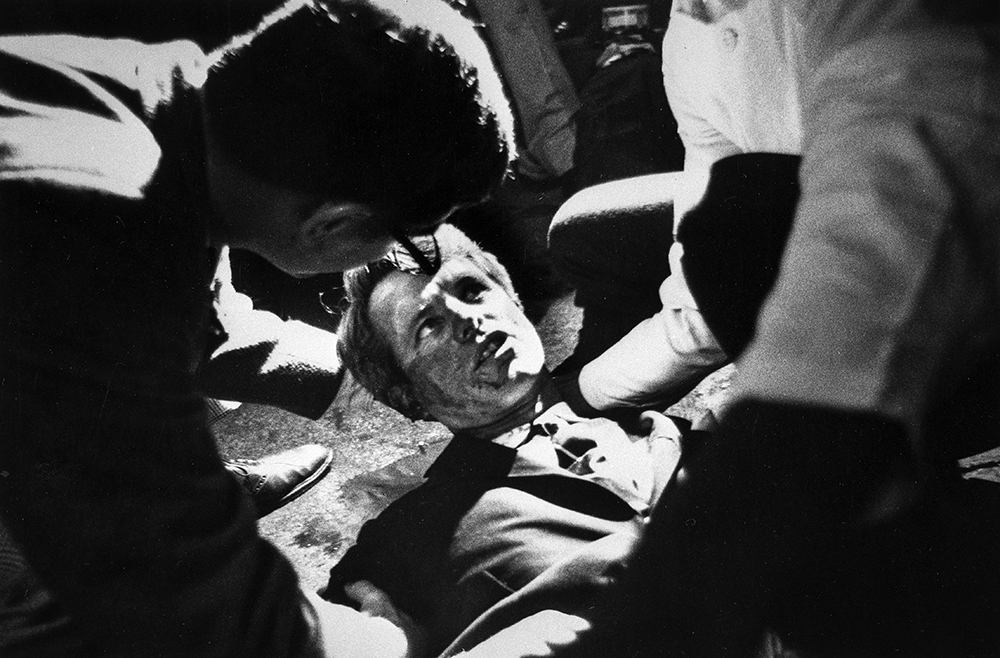
At least, that’s what Robert F. Kennedy Jr. argued in his foreword. He also echoed his oft-stated beliefs that Sirhan Sirhan did not act of his own accord on the night of the murder of Robert F. Kennedy Sr., and that a grander conspiracy involving three-letter government agencies was behind the fatal bullet which left RFK murmuring “don’t lift me” on the floor of the Ambassador Hotel as the blood fled his body:
First, an official FBI report indicated that more bullets had been fired than could have fit in the barrel of Sirhan’s gun. Secondly, an autopsy concluded that Kennedy had been killed by shots fired at point-blank range (approximately six inches or less), but no eyewitness placed Sirhan’s gun that close to Kennedy at any point. Finally, and crucially, the Los Angeles Police Department repeatedly misrepresented the evidence of the crime scene throughout the investigative process. When documents were eventually released to the public in 1988, the milestone was tainted by the words of John Burns, California state archivist, who announced that just three months after my father’s murder the LAPD had inexplicably burned over two thousand photographs of evidence, the contents of which remain completely unknown.
If you’re a dedicated Kennedy assassination researcher, you’re probably familiar with these crucial signposts towards a consistent logic of conspiracy. The foreword offers nothing forcefully new on the front of case-fact.
More interesting is the brief index that tells us the estimated date of creation of each piece. In September of 1966, Sirhan fell from a mare at Granja Vista del Rio Thoroughbred Horse Farm, where he worked while training as a jockey. He was hospitalized, though not much is known about the medical treatment he received, the doctors he received it from, or the extent of the damage to his brain that lingered even after his dismissal from care. Sirhan’s own brother spoke of the permanent personality shift enacted by the collision of malleable skullbone with the hard clay of southern California: frequent, devastating headaches, uncharacteristic irritability, and profound paranoia.
The first pieces included in the collection, chronologically speaking, are a group of short poems punctuated by rhetorical questions and razor-sharp imagery, dating from October of 1966. According to the timeline provided by the editors, there is no conceivable way to know if Sirhan jotted these brief, buzzing sentences from the confines of a hospital bed or the comforts of home, but they seem clearly emblematic of the traumatic experience that had recently befell the author. An example, preserved in the fullness of its presentation in Letters To The Sun:
It’s a spider web.
It is trying to catch something, yes?
Yes, to catch and spin its own silk exponential.
How big? Decaying?
Consuming the entire nation with the first firing
of a single synapse.
And there’s a spider?
A widow and a recluse.
And from whence strung up?
The self, unexpected, like hair into eyes.
Can I taste the web?
Only tangentially through touch.
Bask in toxic softness?
Whistles coded into rattles.
How many lies have you slipped in your life?
Enough to make my words stilted and difficult.
Shout my name to the hilltop until it shakes the mountain.
Until vowels congeal
Forever into my freedom.
Less than two years after writing this poem, Sirhan would invite hatred by championing the fame that came to him after killing RFK, bragging that it took a mere moment for him to acquire the notoriety that Kennedy had garnered over decades. To consume the entire nation with the first firing of a single synapse. The recluse making a widow out of slipped lies, congealed vowels. Shout my name to the hilltop until it shakes the mountain.
Please, bear with me. Please, bear with me. Please, bear with me. My name is Caleb Willett and my arms feel stiff and numb. I want to run around sticking pins into everyone just to see if they are normal. It is now that I must again digress into the personal, this time permanently.
The recognition of one’s life as a spiderweb, one’s self the spider constantly seeking the expansion of its own silk exponential. That one can only taste the web tangentially through touch. She, who thought armor gestalt self private, nude a giant furnace under bounded skies, heat a metanoia herself out of, torn a sundress flutters shapes into surprise.
When I was sixteen, I too suffered a traumatic brain injury. After a nagging hamstring strain kept me limited for much of the fall soccer season and desperate to prove myself on the pitch, my coach substituted me in at striker for an inconsequential ten-minute shift late in a blow-out. Four minutes later, I was lying on the bloodied grass unconscious as my teammates frantically waved their arms and swore. I had attempted to challenge the opposing team’s goalkeeper for a header. That split-second decision resulted in a fractured jaw, dented skull, major facial reconstructive surgery, and a five-week stay in the Danvers State Hospital, which, far removed from its infamous twentieth century heyday as the State Lunatic Hospital at Danvers, I found quite bucolic.
The doctors were concerned not just with my physical condition, but also with my mental state, potentially compromised by both the severity of the injury that my brain had withstood and the sequestration now taking place as I recovered. And they were right to be worried. Though my spirits remained relatively stable, my internal wiring became slightly obsessive. For weeks, everything that I thought refracted through two strange images, undoubtedly influenced by the angsty adolescent interest in occult texts that I had been cultivating before my injury. Prone in my propped-up hospital bed, I understood myself as a spider floating in the midst of a stainless steel web. And simultaneously, I became oddly attached to the image of my unconscious body swallowing its own tongue. This misleading common parlance suggests that the throat overrules the mind and acts autonomously to block one's airwaves, but what really occurs is more of a slippage. Gravity pulls the tongue downwards. Someone choking in such a manner usually just needs to be flipped on their side.
In the hospital bed, I imagined myself a spider and all of my limbs lolling tongues dragged down by gravity. I found salvation in the image of a man, bent backwards at the waist, his countless limbs folding back behind his body like a cryptid centipede. The pages of the small notebook that the doctors allowed me to keep for brain games became dotted with tautological phrases elucidating my new theology. I truly sound insane, as I suppose I was, temporarily:
Every glance of mine towards a mirror merely returns myself, arms bent back. For when envisioned, all rotates but my arms, and so suddenly they snap in place again. Think about it; left again left, right right. Rejecting reflection and making it true, again. I am thinking of negative dialectics. How it is not each action having a reaction equal and opposite but rather each action reacting against itself as part and as whole. For your sake, reach your arms back, drop your head that it compresses into your chest. Make a mess of the breastbone. What you assume is none other than the death posture. You will be intensely exhausted as you bridge the mind and body to carve goals into the psyche. I can almost feel the vertebrae busting out of their collar; my shoulders double-joint upwards into a place with the same appeal as heaven. Legs crossed, like always. Moving my mind into a state of gnosis, the ascension to the unconscious. There I am. I feel like I know him, but sometimes my arms bend back? But there, and then, I am arms right, and here, and now, arms wrong. But does not a pig on a spit too retract his limbs? And what am I when transcendent if not vulnerable? There’s faith in my arms out of socket-context. And I think it’s finally time to take my face off.
You would be forgiven if yet to ascertain the purpose of this review. I concede that my summation of Letters to the Sun is largely lacking, and my murmurings heretofore on the relationship between myself and Sirhan Sirhan seem largely digressionary if not decorative. I beg for your forgiveness, then, for my shortcomings. It is not easy to articulate feelings that flirt with insanity. Reading Sirhan’s spider-web poem for the first time last April, I was instantly returned to my hospital stay for the first time in years. It is not enough to say I saw myself in his fragmented sentences; for some spell-binding seconds I genuinely thought that the words were mine. Why did we both see spider webs with our fucked-up heads? I will give Letters to the Sun credit. It is hard to put a book down when it seems as if it is made for you, but even harder when it seems made by you. I cannot tell my friends how deeply I relate to this anthology. They would not believe me, or believe me crazed. The impartial Amazon community will instead receive my screed. Do with it as you please. In the transcendence of knowledge, which is repetition, we find wisdom.
In the transcendence of knowledge, which is repetition, we find wisdom. You would be forgiven for doubting the triangular link I have drawn between myself, Sirhan Sirhan, and spider webs. It seems even to myself a faithless, baseless trinity. But after reading that first poem and finding myself on fire, reflected, I spent the rest of the weekend entranced, scraping Sirhan’s collection for words I could identify as retreads of myself. Two pieces in particular hollowed out my foundation. The first, his interrogation of the etymology of the word “assassin.” Written early in 1967, the piece is emblematic of that quality of Sirhan’s writing so prevalent in his disjointed diaries; manifestation dribbles down the sides of each sentence, overflowing from the words. It is as if Sirhan had produced a study of his own future:
Assassin. Three beats, full of grace – that final “-sin” syllable pulling most of its parent’s murderous weight. Aurally, the word hisses, as the mouth dances and jabs like a cobra around its double consonants. Written, made manifest, the s’s stretch out and divide the torso of “assassin” like a four-banded armadillo. Language gets its power from repetition; power develops its own language out of repetition. Repetition – the raw materials of knowledge appearing before us twice, confused, contradictory. Wisdom is just the transcendence and mastery of repetition.
History repeats itself, and our great obsession should be investigating the stage magic facilitating that aphorism. Assassin. From the French and Italian assissini. Are assassin and assissini mutually intelligible? In translation, repetition. Assissini, from the Arabic hashishin, a nickname given by Westerners, including Marco Polo, to the Nizari Ismaili sect of Muslims who, in the twelfth and thirteenth centuries, lived in Syrian and Persian mountain strongholds and guaranteed their own protection and sovereignty through frequent, politically-motivated, extra-judicial killings. The sect called themselves Asāsiyyūn, meaning “those faithful to the foundation of the faith.” Western Christian Crusaders, ignorant of Arabic, assumed this name must derive from hashish, and that the Ismaili Muslims consumed hashish before killing, leaving them in a berserker-like trance. This was not true. In Italian, the name stuck. Dante used it in the nineteenth canto of the Inferno. Hell has nine circles – the form of repetition. Now, the English word for a political killing stems from a racist misunderstanding.
Do you see what he is saying here? In the transcendence of knowledge, which is repetition, we find wisdom. Why is it that our epistemologies seem identical? It is not just that Sirhan’s words presage his own future. They also presage mine. For a college course, one that took place over the course of a desolate fall a few years ago and has since all but retreated from memory, I once briefly analyzed the relationship between Sirhan Sirhan and the word assassin, captured by the boundless repetition in the physical structure of the words themselves. I don’t even think this assignment was graded:
Sirhan Sirhan. Assassin. Sirhan Sirhan. When people learn about the assassination, assassination, assassination, of Robert F. Kennedy, they get hung up on Sirhan Sirhan’s same-name double-name. It is striking. It is not something we see often in names common to English. The repetition itself is othering. The word assassin arrives to us in English from misguided understandings of language and culture, from a racialized, willful belief that Muslim people enter violent trances for fatal purposes, from Crusaders usurping land that was never their own out of devotion to the Holy. That is the story of “assassin.” And there are traces of the word’s story in the story of Sirhan, who has become one of the word’s foremost examples.
Are not these two passages the clear and distinct work of the same author? Yes, it is eerie that Sirhan wrote with such clarity on the ramifications of the etymology of a word that he would later come to embody. Is not it more eerie that this paragraph, which would not be unearthed until many moons after I had produced and forgotten the snippet of my writing excerpted above, seems a direct and uncompromising influence on my words? How can I even begin to make sense of a connection that flaunts time so blatantly? I trust you so much, dear reader, with the words that I am now typing, for I am aware that they seem genuinely unhinged and yet I long to share them with you regardless. Picture me as a lawyer for the defense, straining to not allow the prosecution judicial sanction of restriction of investigation, systematically sanitized. Doth the lady protest too much? The lady doth protest too much, but I must, I must, I must. I fear losing my voice would be to lose myself. Fearlessly, I must. I must provide idle speculation, volunteering everything and nothing at once. Join me and help me reconstruct body and mind parallax. The mirror is broken and in the shattered glass I see other than myself.
Forgive me, I am getting ahead of myself. Forgive me, forgive me, I am getting ahead of myself.
The crown jewel of Letters to the Sun is Sirhan Sirhan’s never-sent epistle to Rosemary Kennedy, the forgotten, lobotomized member of that royal family. The brief editorial introduction to this letter, which has thoroughly captivated the few critics with the chutzpah to read and comment on Sirhan’s work, mentions that it is unclear how exactly Sirhan knew of the existence of Rosemary, why he would write a letter to her, if delivery was ever intended, or if Sirhan drafted letters to other Kennedys. Similar confusion, says the note, surrounds the content of the letter. Sirhan appears to refer to the details of a life other than his own.
The how and the why of everything that is who we are is unclear. Excerpts from Sirhan’s letter, selected by yours truly:
In the treasure that he took shines polished care that you maybe had too much of, and now have nothing. I run my hands over grooved bronze and protruding tusks dancing the shores of the elbow, poking holes in starched cotton with drachmas bearing strong resemblance. I’m a Massachusetts boy too, Rosemary. I wish we could have looked east arm in arm. Your father would have called me a queer; we could have run off to the dunes for a day, run screaming from the beach after beaching a bull shark basking. I look west, too, Rosemary. Where the sun sets. Moguls turned the meadow you spent your last July into; still the candy-red lighthouse stripes resist repainting. The newspapers whisper of a carousel, new languages coughed and hexed. Where did you go, Rosemary? Do you have a nickname for your hate and can I use it? My lungs are burning I want so badly. Someone with my own name to love, to shadow me in sound and laugh when I get ready to never get to the party. Do we have four infants, Rosemary? I am sped-up. I am inhibited. I see your face every day outside my window. Who are they still protecting? In my boiling brain you bubble and pop for the same reason. There should be a day for you the way there are weekends.
You may see where this is going. These words rip through me like a whistling wind on an unbroken tundra. They are me. Sirhan Sirhan was not a Massachusetts boy, but I am. When I was eight years old, I ran from the water screaming, a shark fin mere meters offshore behind me. My mother took a picture; we later identified the great fish as a harmless basking beast. Why are my own distant memories reappearing in the work of the man who ostensibly assassinated Robert F. Kennedy thirty-three years before my birth? I am in love. My girlfriend and I have nicknames for each other that make little sense. They often call me their “weekend;” when we are together stress and worry disappear, if only for a strictly temporal moment. Why are my intimate pet names blaring back at me from a letter written by Sirhan Sirhan to Rosemary Kennedy? More:
I want to lie in a pile of honeybees and have them drop honey slowly onto my palms, and then I clasp them, and then into my palms their stingers. Can’t you see that I love you, Rosemary? I want to turn the people you know least inside out and fold them wrongly. There is too much distance between. I have no authority and I write to ask if therein we find clarity. Come to me, Rosemary. I see you outside the door now. I want you privately. I will come to you, Rosemary, and I will dictate to you the morning light, and I will trace its warmth across your hand. Lead a shiver down your spine and up your inside. I am just like you. This world made me a parent of my legacy. But when nails slip, I gently paw at boards. This is not a world for me.
I want to scream, lie in a pile of honeybees and have them drop honey slowly onto my palms, and then I clasp them, and then into my palms their stingers. I want this. It feels not like a desire I have read and interpolated, but rather a desire I have desired. I promise you, these words are mine. Lead a shiver down your spine and up your inside? I said that in bed one night last September and my love laughed. Imagine the terror in the back of my mind when I read it back again a month later in the published words of another. Or, from a brief review of a tune I wrote in August:
Oh, how we yearn for freedom, yet when nails slip gently paw at boards! So yells the song.
Those are my words. I wrote them before I ever read them. But they appear in Letters to the Sun reproduced almost exactly in form. What am I to do with this knowledge? Is this even knowledge? What are the chances of such synchronicities all appearing at once, localized in the relation of two people, so distinct in time, space, role, and action? I do fear I am losing my mind. These similarities are undeniable, but I so want someone to deny them. In the transcendence of knowledge, which is repetition, we find wisdom. Why do I feel nothing but terror? Is this not the transcendence I have sought for myself? Where’s the shattered sand when I stand before a broken mirror, flawed? How come every day feels more and more contrived? Am I the keratin on the table or the purring cat declawed?
Remember those trips we used to take to the elbow of Cape Cod? And how time itself, unoccupied, seemed to twist and bide? Would you rather hang in public or fall towards a firing squad?
I apologize to those who have read this far and are expecting some resolution. There is none. This is not a narrative, it is a cry for help masquerading as coherence so as to build its own sincerity. I do fear I am losing my mind. I long for someone to tell me that this is all in my head, but I no longer know the boundaries which constitute my ego. I have forever been predicted. Last week, I was Ubering to my apartment in Brooklyn from a bar in a different borough. A little drunk, I thought of Letters to the Sun. I looked into the tinted rear view mirror and saw, smiling back at me, a forever youthful face that I could barely recognize. Around him greenheads, greenheads, greenheads.
A breakage: my selfhood dissolved. Space and time ran concurrently at once; left again left, right right. Rejecting reflection and making it true, again. I thought of negative dialectics. How it is not each action having a reaction equal and opposite but rather each action reacting against itself as part and as whole. I thought, and I began to split in two, a separated self half emitted outwards, half devouring my own insides. The surely septic, slightly sexy corpus husk flickering in the leather seat and the spectral solidity beside it. I realized, with a jolt, we were weaving both east and west. The driver started staring at me expectantly through the rearview while looking right at the road ahead. The Queensboro Bridge bore us to both Queens and Manhattan. A red-light. I felt that deepest in my stomach. Once you get into a certain kind of rhythm, a deviation is a betrayal is a pugio. When that rhythm is life, a deviation is a little death, unprocessable.
I apologize to those who have read this far and are expecting some resolution. I am not providing any answers. I am looking. I am searching for the great deception I have worried into existence. When I stumble across streets, men wave to me from eighth floor apartments, sipping ground-level tea, pouring out libations for the still sepulchered living. Everything green and pink and rosy frosts over into a beautiful winter.
I long for a country where the blue sky stays blue and the sun shines. I crave a complete map of the terra cognita of my known self and its designated demon. Before the altar stands a priest, and so the altar becomes an altar again. I want more from existence than just a strategy of tension. Please tell me that I am who I am and only who I am. Please tell me that I am who I am and only. Please tell me.
24 people found this helpful
-- Caleb Willett splits his time between the North Shore of Massachusetts and New York City, drawing on both environments as sources of inspiration for his experimental poetry and fiction. You can find him on Twitter @calebwillett5